September 11, 2026
Kitchen Cabinet Refinishing Cost Calculator Explained
A typical kitchen cabinet refinishing job lands around $1,500 to $5,000, with 2026 averages near $2,850 to $3,116 and professional refinishing often working out to about $4 to $10 per square foot. In most cases, labor drives the total more than materials, so the fastest way to understand a quote is to look at prep, finish type, and cabinet condition first.
That's the part most Austin homeowners run into when they're staring at a cabinet quote in the middle of a kitchen they still have to live in. You're trying to figure out whether the number makes sense for a Cedar Park ranch, a West Lake Hills remodel, or a starter kitchen in Pflugerville, and the online calculator looks simple until the estimate comes back very different from what you expected.
Table of Contents
- How This Kitchen Cabinet Refinishing Cost Calculator Works
- Calculator Inputs Glossary and What Each One Means
- Labor Materials and Overhead Breakdown Behind the Total
- Finish Types and Application Methods That Change Your Estimate
- Sample Calculations You Can Copy for Your Own Kitchen
- Refinishing Versus Refacing Versus Replacement Decision Guide
- Austin Area Pricing Adjustments and Local Considerations
- Quick Reference Worksheet and Bid Comparison Checklist
How This Kitchen Cabinet Refinishing Cost Calculator Works
A kitchen cabinet refinishing cost calculator should do more than spit out one total. It needs to turn your kitchen into a set of inputs, then show how those inputs change the price before anyone opens a paint can. That's useful in Austin, where one homeowner in Round Rock may have a compact painted kitchen with easy access, while someone in Dripping Springs may have older doors, more repairs, and a finish choice that pushes the quote upward.
Start with the project, not the website
Think of the calculator as a translation tool. You give it cabinet count, finish type, condition, and access, and it translates that into labor time, materials, and overhead. That logic matches published pricing guides that keep refinishing in a relatively narrow U.S. range of about $1,500 to $5,000 and place typical averages near $2,850 to $3,116 (HomeWyse pricing guide).
The reason that range stays fairly tight is simple. Refinishing keeps the existing cabinet boxes and doors in place instead of replacing them, so the job is mostly about surface prep and finish work, not demolition. That's why the same calculator can produce a low number for a small paint-only kitchen and a much higher number for stained cabinets with repairs and premium coatings.
Practical rule: If a calculator doesn't ask about door count, repair level, and finish type, it's giving you a rough guess, not an estimate you should trust.
Use the rest of this guide like a worksheet
The easiest way to read a quote is to break it into pieces, then compare those pieces to your kitchen. If a bid from Austin or Lakeway seems high, check whether the contractor counted doors and drawer fronts separately, whether prep was included, and whether the quote assumes spraying, hand application, or a premium coating system. That's where the detailed cost breakdown lives.
A lot of homeowners start with a calculator because they want a fast answer. The better use is to treat it like a checklist, then use the later sections for inputs, sample math, and local pricing so you can tell whether the number is realistic before you invite anyone out for a site visit.
Calculator Inputs Glossary and What Each One Means
A good calculator asks the same questions a contractor asks on site. It doesn't just want the room size, it wants the cabinet count, condition, and finish details that change the labor involved. That's why a kitchen in Cedar Park with simple slab doors can price very differently from a Steiner Ranch kitchen with lots of trim, panels, and hard-to-spray edges.
Cabinet count and door or drawer count
Cabinet count is the number of boxes in the kitchen, while door and drawer count is the number of faces that have to be removed, prepped, finished, and reinstalled. Door and drawer count often matters more because every panel adds handling time. If a calculator asks for both, use the door count as the more detailed input.
For a 10x10 kitchen in Cedar Park, the total cabinet boxes might look modest, but the door count can still climb fast once you include uppers, lowers, drawers, and a pantry.
Linear feet versus square feet
Linear feet measure the run of cabinetry, while square feet measure surface area. Some Austin-area pricing pages use linear feet, while national refinishing guides often lean on square footage, so it helps to know which measurement the calculator uses. A linear-foot quote is usually easier for a homeowner to compare quickly, but square-foot math can be more useful when the finish system or total surface area drives the price.
Surface condition and repair level
Condition means how much cleaning, sanding, filling, and repair work the cabinet faces need before coating. Light wear, heavy grease, chipped paint, deep scratches, and swollen edges all change the estimate. A kitchen in Buda with older cabinets and visible wear needs a different prep plan than a newer Austin condo kitchen with clean, intact doors.
Finish type and application method
Finish type covers paint, stain, glaze, or premium coating. Application method means spray booth, on-site spray, or hand brush and roll. Those choices affect both the look and the labor. If your calculator asks about finish system, choose the option that matches your actual goals, not just the cheapest one.
Hardware, removal, and access
Hardware includes knobs, pulls, and hinges if they're being replaced. Removal and access cover how easy it is to get doors off, move them, and protect the room during the job. Tight layouts, second-floor kitchens, and kitchens with awkward parking or limited staging space can all add effort.
For a quick example, a Lakeway kitchen with easy access and simple hardware is a different job from a Bee Cave kitchen with high-detail doors and a tight workspace. The calculator should reflect that.
Labor Materials and Overhead Breakdown Behind the Total
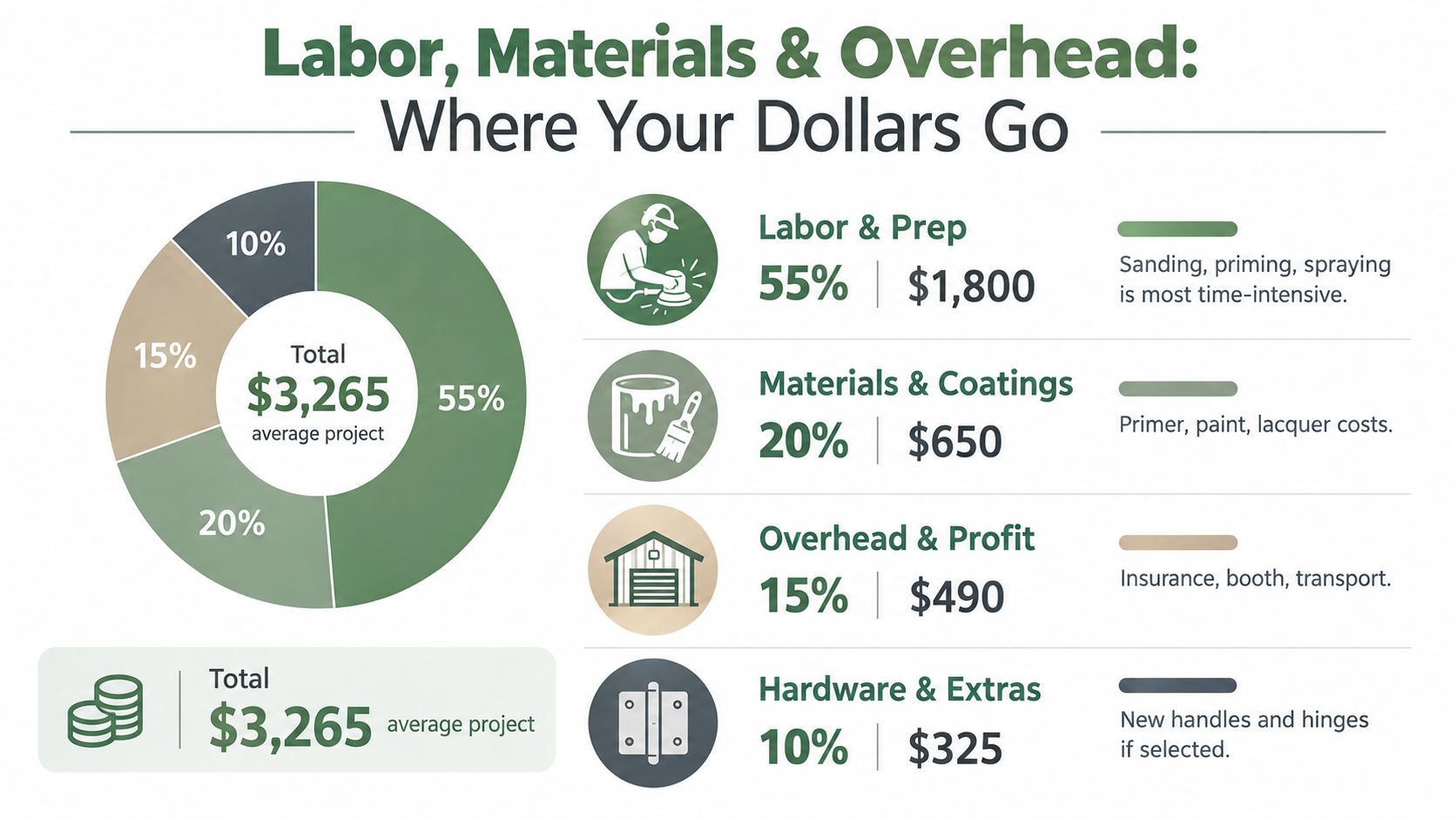
A lot of homeowners start with the paint or stain price and miss the bigger number. The finish material matters, but the cost usually sits in the hours it takes to clean, sand, repair, mask, spray, cure, and reinstall each piece. That is why national pricing guides keep pointing back to labor as the main driver in cabinet refinishing costs, as shown in the HomeAdvisor cabinet refinishing cost overview.
Why labor dominates the estimate
Cabinet refinishing is a prep job first and a color-change job second. Every surface has to be cleaned, made smooth, and ready to hold the new coating, or the finish will not last the way it should. In Austin-area quoting, including line-item approaches like the one used on cabinet refinishing service pages, the scope and finish system usually shape the price more than a simple room-size guess.
Two kitchens with the same footprint can land in very different price ranges. One may only need degreasing and a paint-only coating. Another may need repairs, grain work, stain restoration, or a more detailed spray process. The materials do not change as much as the labor hours do.
A useful way to read the quote is to ask, “What part is hands-on work, and what part is supplies or setup?” That split makes the total easier to compare.
How a real estimate is usually built
A practical estimate usually breaks into four parts.
- Labor: sanding, prep, masking, spraying, curing, reinstalling.
- Materials: primers, coatings, fillers, cleaners, and protective supplies.
- Overhead: shop time, insurance, transport, and setup.
- Hardware or extras: optional hinge, handle, or pull replacement.
The share of each part changes by job, but the structure stays the same. A smoother kitchen with fewer repairs needs less labor. Older cabinets push the quote upward because the prep takes longer, and more prep means more time on site or in the shop.
How to read a custom quote
If a bid looks unusually low, check what got left out. Some quotes only cover color application, while others include cleaning, repairs, and reinstallation. Ask for the scope in writing and confirm whether the contractor plans to spray in place, use a booth, or hand-finish certain parts. That difference matters because a low number can hide extra work that shows up later.
For homeowners comparing Austin bids, the cleanest approach is to separate the estimate into labor, materials, and overhead, then compare each line instead of only the final total. That makes it easier to see whether one contractor is cheaper or just leaving out part of the job.
Finish Types and Application Methods That Change Your Estimate
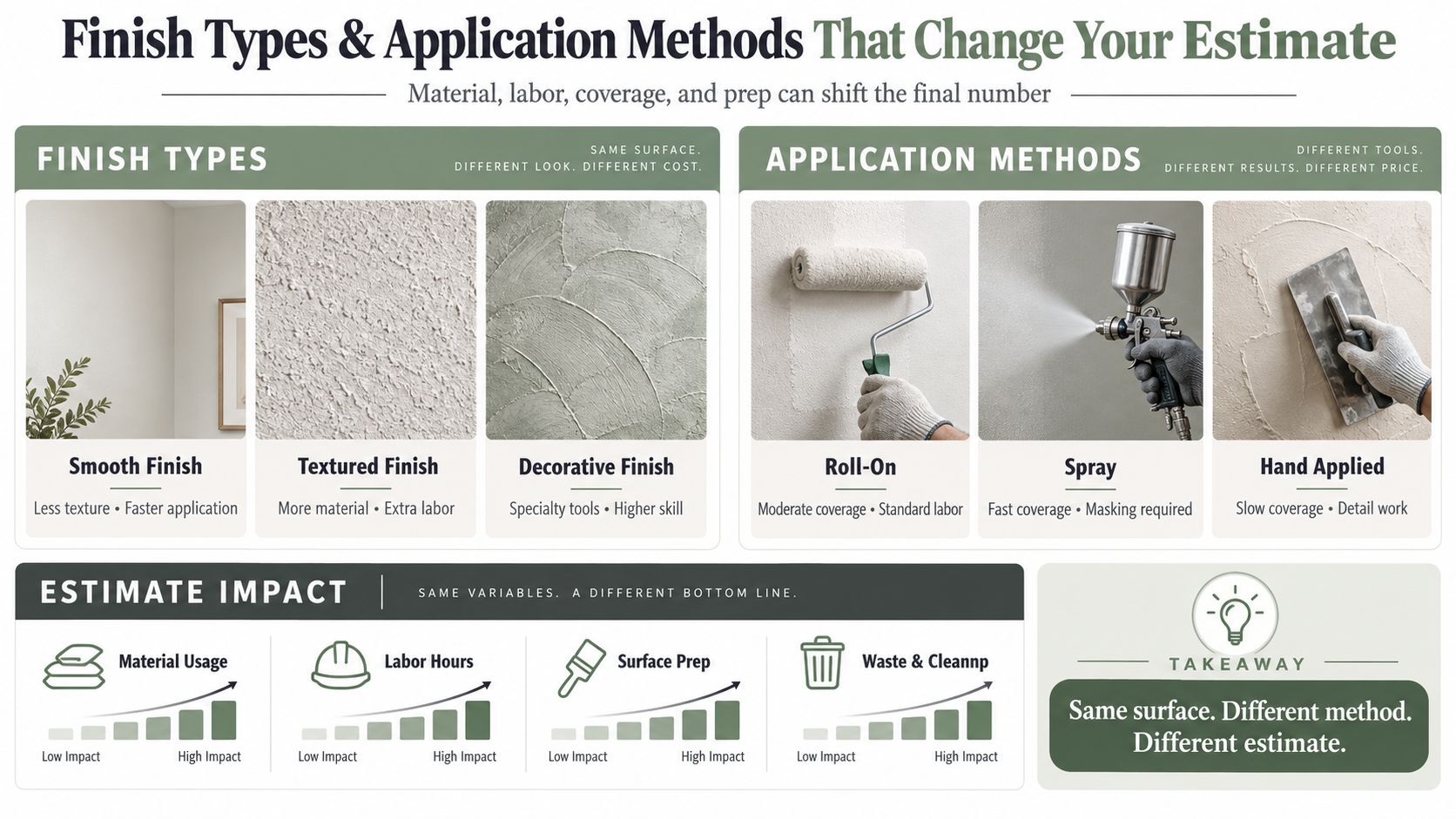
A finish choice can change the quote as much as cabinet size does. A homeowner in Austin might start with one idea, then learn that the cost shifts with prep, coating system, spray setup, and cure time. Once you see those parts, the estimate makes more sense.
Paint, stain, and glaze don't cost the same
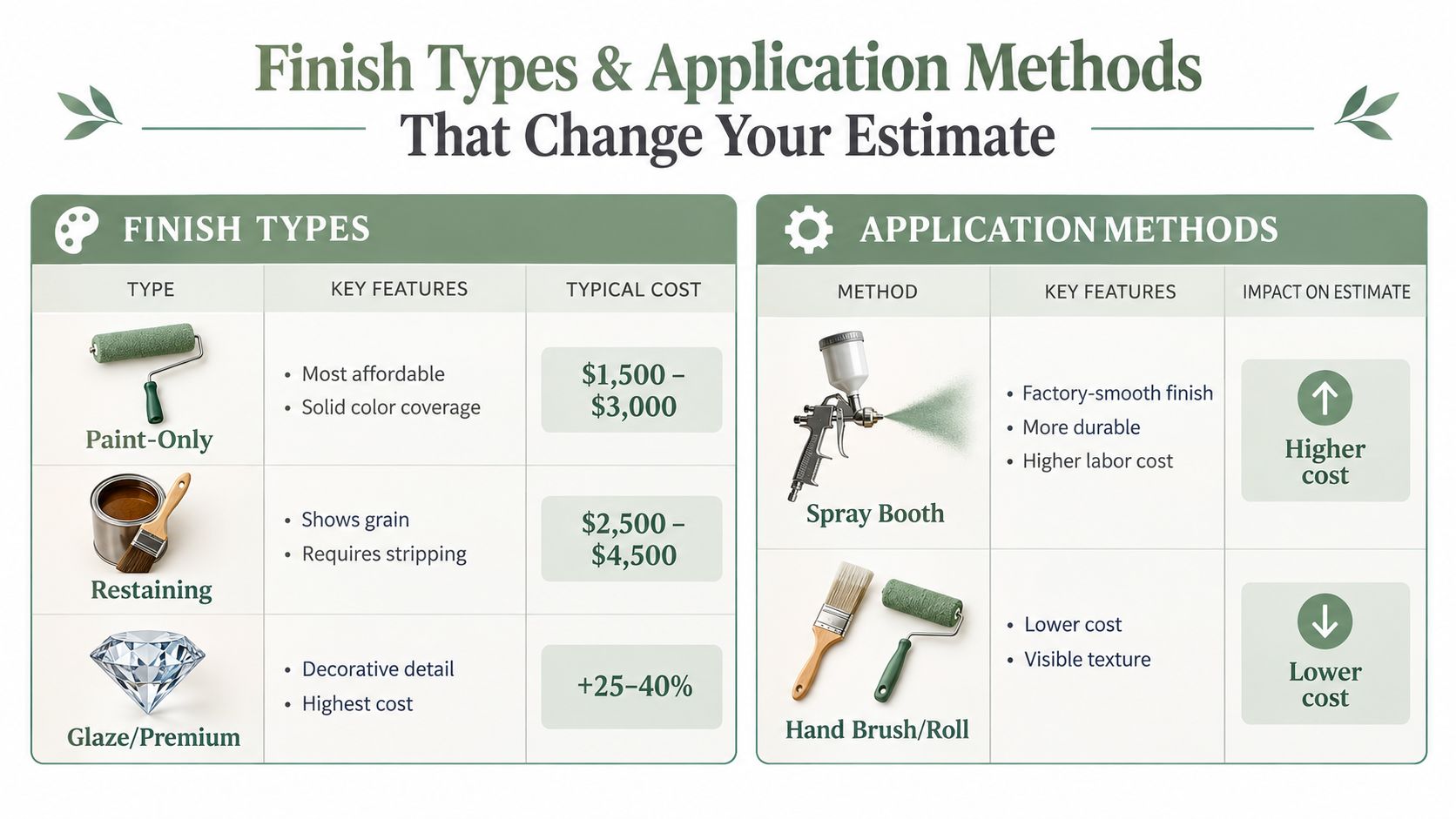
A paint-only finish is usually the lowest-cost path because it covers the surface with a solid color and avoids deeper wood-tone correction. A restain project takes more control, since the wood grain still has to show well and the surface may need stripping, sanding, or color balancing. Glaze or premium coatings add decorative detail and more labor, so they usually sit higher in the quote.
Paint fits a kitchen that just needs a clean update. Stain works better when the wood grain still looks good and the homeowner wants that natural look to stay visible. Glaze fits a more layered finish, where the goal is more character than simplicity.
Spray booth versus hand application
A spray booth or controlled spray process gives a smoother, more factory-like result. It also adds setup time because the kitchen must be masked, protected, and handled carefully while the coating is applied.
Hand brush and roll methods can reduce setup, but they usually leave more visible texture. That tradeoff matters in Austin homes, where bright daylight can make brush marks easier to see. Homeowners who want a cabinet surface that looks factory finished usually end up comparing spray work against lower-prep hand application.
What Texas conditions do to the decision
Heat and humidity do not change the calculator formula, but they do affect finish expectations. Cabinets in a busy kitchen need a coating that holds up to daily use and temperature swings. A smoother sprayed finish often earns its place there because it can deliver a more even surface and a cleaner final look.
A good quote should also spell out what the contractor means by spray work. Check for prep steps, coating system, masking, whether spraying happens in place or in a booth, and the expected cure time. Those details tell you more than a polished sales pitch ever will.
Sample Calculations You Can Copy for Your Own Kitchen
Two kitchens can share the same floor plan and still land thousands of dollars apart. The difference usually comes from prep, finish type, and how much labor the job needs. Once you can see those moving parts, the calculator starts to make sense.
| Input | Small Paint Only Kitchen | Larger Stain and Repair Kitchen |
|---|---|---|
| Cabinet scope | Fewer doors, simpler layout | More doors, more detailing |
| Condition | Light prep only | Repair-heavy prep |
| Finish type | Paint only | Stain and detailed finish |
| Labor share | Lower labor time | Higher labor time |
| Materials share | Modest | Higher than paint-only |
| Final estimate | Lower end of the range | Upper end of the range |
Example A, a small paint-only kitchen in Pflugerville
Start with a compact kitchen in Pflugerville or Hutto, where the cabinets are structurally sound and only need a painted finish. That kind of job sits near the lower end of the typical national range, because the prep is lighter and the finish steps are simpler.
Labor still carries most of the weight. Even on a small kitchen, sanding, masking, and cleanup take time, while materials stay lighter because the coating system is basic. If a quote comes back high for a small, sound kitchen, look for hidden repair work or extra finish steps that may have been folded into the number.
Example B, a larger stain and repair kitchen in Lakeway or Bee Cave
Now shift to a larger Lakeway or Bee Cave kitchen with older doors, more repair work, and a stain-focused finish. Older wood usually asks for more careful prep, and stain work gives less room to hide flaws than paint does. That is why the total climbs faster.
Per-square-foot math helps here. National guides show professional refinishing often around $4 to $10 per square foot, with broader estimator ranges getting higher when site conditions and options are included (HomeAdvisor cost overview). A kitchen with older surfaces rarely belongs at the cheapest end of the range, even if the layout is not especially large.
The labor and materials split matters in plain English. Paint-only work is usually more like a simple house repaint, while stain and repair work behaves more like fine furniture restoration, where each extra step adds time.
Simple test: If a quote for an older kitchen looks like a brand-new-door job, it probably missed the repair labor.
Refinishing Versus Refacing Versus Replacement Decision Guide
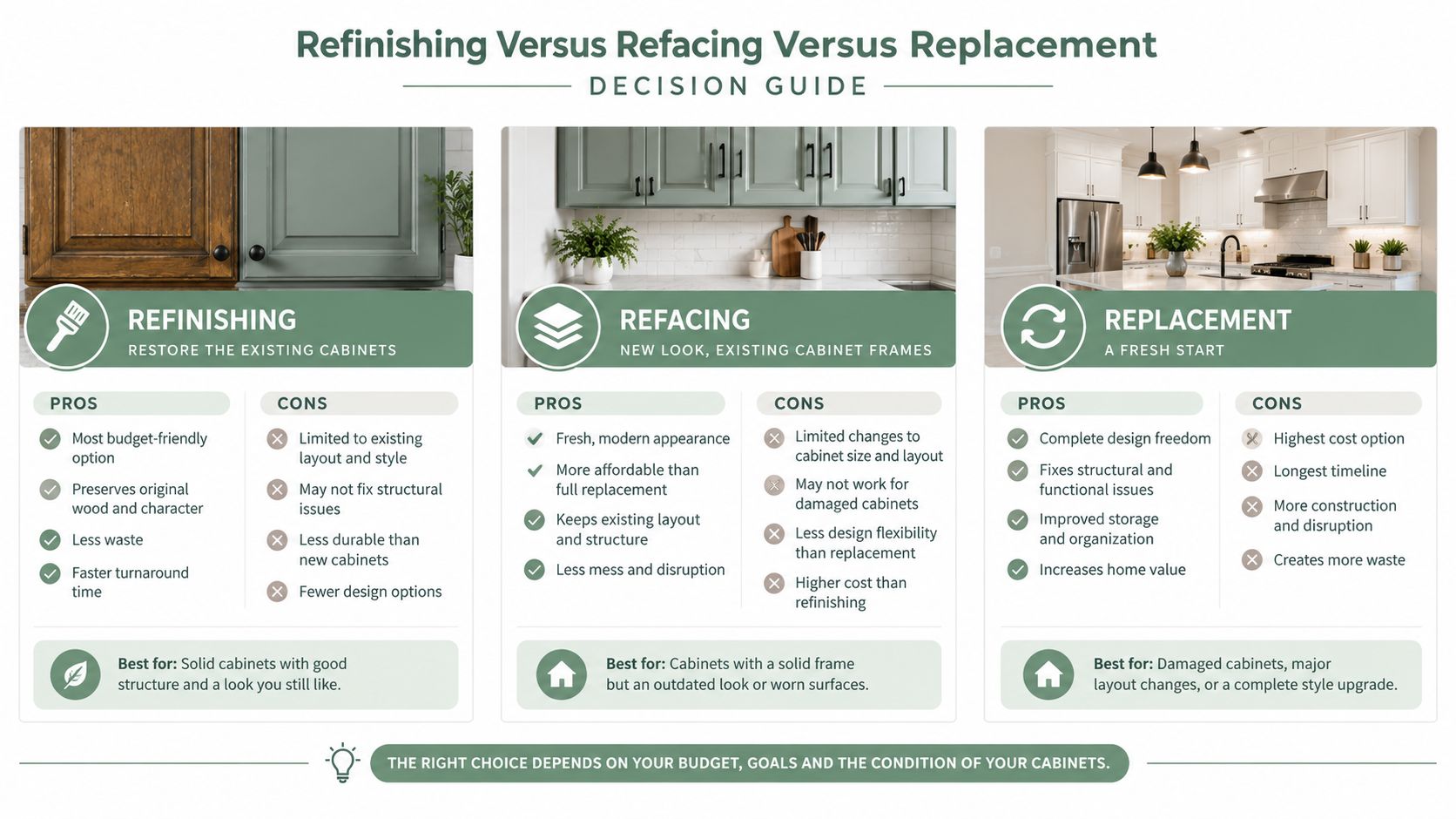
A cabinet project can look simple on paper and still point to three different answers. The right choice depends on what is staying, what is worn out, and how much of the kitchen you already plan to change. Refinishing works best when the layout stays put and the cabinet boxes are still solid. Once the boxes are damaged, the footprint changes, or the homeowner already wants new countertops and lighting, refacing or replacement usually fits the project better.
When refinishing makes the most sense
Refinishing usually wins when the kitchen layout works and the boxes are in good shape. It is the right choice when the goal is a visual upgrade without tearing the room apart. In the same comparison guide, refinishing is shown as running about 60% to 80% less than full cabinet replacement (CostToRenovate comparison guide).
That gap is why a refinishing calculator helps Austin homeowners in Georgetown, Leander, and Kyle make a cleaner first estimate. If the structure is sound, refinishing can deliver the update without turning the job into a larger remodel.
When refacing or replacement starts to make more sense
Refacing makes more sense when the cabinet boxes are usable but the doors and drawer fronts need a new surface. Replacement makes sense when layout changes are part of the plan, or when the cabinets are too damaged for refinishing to be a wise investment. The same comparison guide keeps refacing and replacement well above refinishing, so the point where one option stops being a fit matters a lot.
If you like the footprint and the bones are good, refinishing is usually the right choice. If the kitchen needs structural change, use a broader remodel estimate instead. A good kitchen renovation planning guide can help you separate a cosmetic update from a larger project.
A quick decision check
- Choose refinishing: when the boxes are sound and you want a fresh look.
- Choose refacing: when the structure stays, but fronts need a new surface.
- Choose replacement: when layout, damage, or a full redesign are the goals.
Kitchen budgets are still heavily concentrated in cabinets, and the same comparison guide says cabinets commonly take 30% to 40% of the total remodel budget. That is why the choice between refinishing, refacing, and replacement can shape the whole project.
Austin Area Pricing Adjustments and Local Considerations
Austin pricing works a little differently from a generic national calculator because site conditions matter so much. Local estimates commonly show cabinet resurfacing priced at $150 to $450 per linear foot, while Austin-area project ranges have also been listed around $1,926.92 to $3,853.85 (Angi Austin cabinet cost guide). Independent Austin pricing pages also show Travis County cabinet-refinishing estimates ranging from $762 to $4,240 and another local calculator placing refinishing at $7.20 to $14.00 per square foot (Manta Austin cost page).
What changes the number in Central Texas
The biggest local factors are scope, material quality, labor rates, site accessibility, and the finish system selected. A kitchen in Austin proper may price differently from one in Driftwood or Dripping Springs if the access is tighter, the doors are more detailed, or the finish needs more care. That's why local calculators often feel wider than national ones.
Cosmetic finish work such as paint, wallpaper, flooring, tile, cabinets, and countertops usually doesn't require a permit in Austin, but moving walls, relocating plumbing, or changing electrical typically does, and the City of Austin directs permit filing through its AB+C portal (Austin permit guide). That matters if your cabinet project starts to turn into a larger kitchen change.
Timeline matters too
A simple cosmetic refresh can finish in 1 to 3 weeks, while a mid-range remodel with new cabinets and countertops usually takes 8 to 14 weeks and a full gut renovation can stretch to 21 to 46 weeks (Trussell kitchen timeline guide). Those timelines help explain why refinishing stays attractive for homeowners in Bee Cave, West Lake Hills, Steiner Ranch, and Round Rock who want the kitchen usable again quickly.
Humidity and seasonal storms also matter in Austin-area finish work, which is why local contractors often pay attention to coating selection and drying conditions. A finish that looks fine in a showroom still has to survive real kitchens, real moisture, and real daily use. For a deeper look at finish durability in our climate, see this Austin humidity and finish guidance.
Quick Reference Worksheet and Bid Comparison Checklist
A calculator is most useful when you can turn it into a shortlist for real quotes. Write down your cabinet count, door and drawer count, finish type, condition level, and whether the job needs spray, hand application, or extra repairs. That gives you the cleanest starting point for comparing estimates in Austin, whether you're talking to Restore My Kitchen ATX or another contractor.
One-page worksheet for your kitchen
- Door and drawer count: count every removable face.
- Cabinet condition: note grease, chips, peeling, or water damage.
- Finish choice: paint, stain, glaze, or premium coating.
- Application method: spray booth, on-site spray, or hand finish.
- Extras: hardware changes, repairs, or access issues.
If a quote leaves one of those fields vague, ask for clarification before you compare prices. A detailed estimate should tell you what prep is included, how the finish will be applied, and whether hardware removal and reinstallation are part of the job.
Bid comparison checklist
- Confirm prep steps: cleaning, sanding, filling, masking.
- Verify finish system: ask what coating is being used.
- Check the application method: spray or hand application.
- Ask about cure and reinstall timing: make sure the doors aren't rushed back onto the boxes.
- Review the warranty or workmanship terms: read what the contractor stands behind.
A quote that looks lower may be leaving out work that another contractor included. That's why the exact same kitchen can produce very different numbers. The safest comparison is the one built from the same inputs, the same finish expectations, and the same scope of work.
If you want a quote that's tied to your actual kitchen rather than a generic estimate, Restore My Kitchen ATX can assess cabinet count, condition, and finish goals for an Austin-area home and build the price from there. Visit Restore My Kitchen ATX to request a project-specific estimate and compare your cabinet options with clear numbers before you commit.