September 1, 2026
Kitchen Cabinet Refacing: What It Is and When It Works
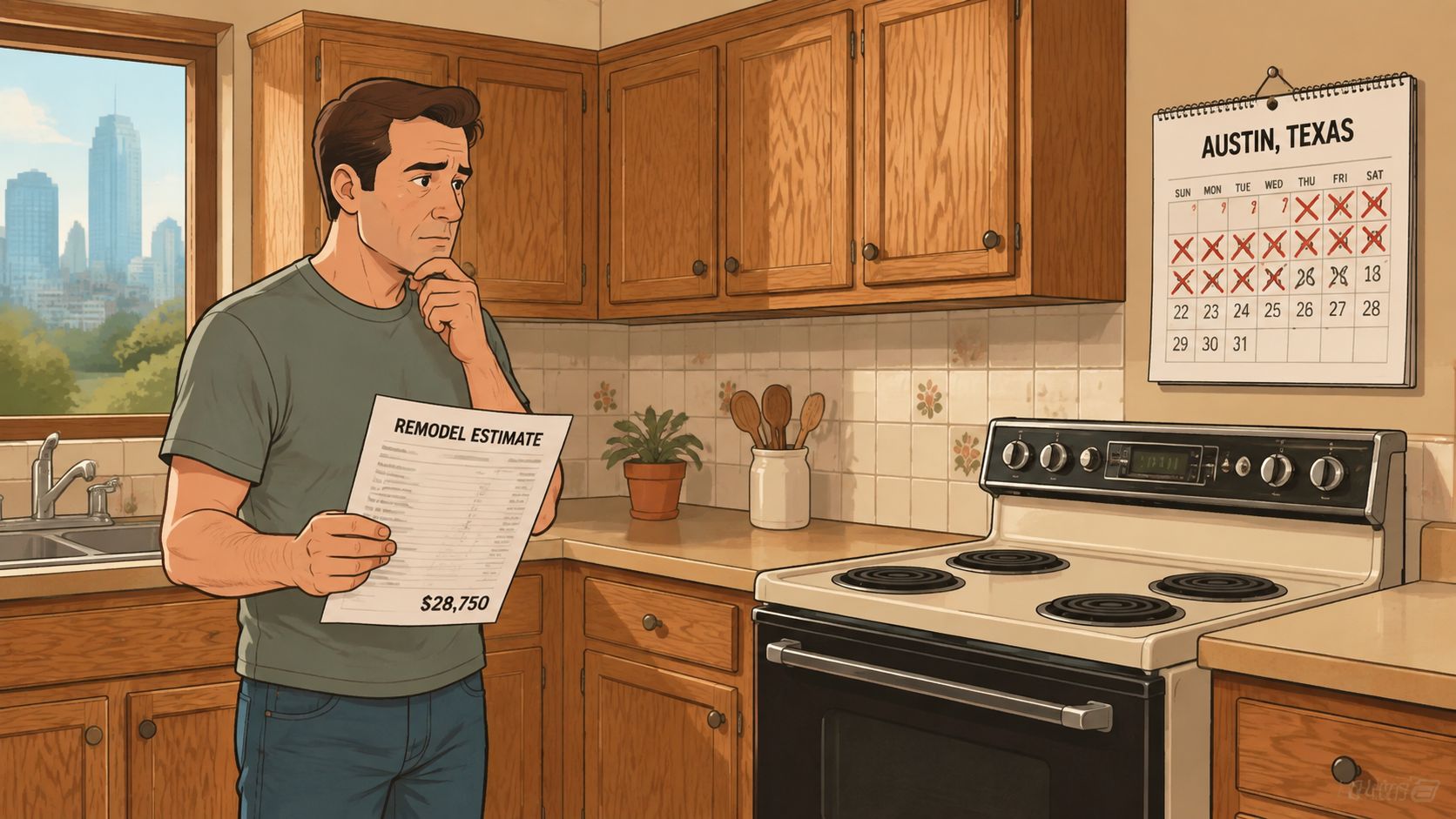
You're standing in a dated oak kitchen in Cedar Park, staring at a remodeling estimate and wondering whether a new look is worth weeks of dust, noise, and disrupted meals. The estimate may assume a full tear-out, while your painter may suggest nothing more than a fresh coat of color. Between those extremes sits kitchen cabinet refacing, a practical option that keeps the cabinet boxes and replaces the visible surfaces.
That distinction matters in Austin homes, where a cabinet's condition, humidity exposure, and proximity to a dishwasher can determine whether a finish lasts or fails early. Refacing can deliver a near-new appearance without changing a functional layout, but it isn't a cure for swollen particleboard, failing cabinet floors, or storage problems. The right question isn't just, “Can these cabinets look better?” It's, “Is the existing cabinet box a foundation worth keeping?”
Table of Contents
- The Kitchen Update Most Homeowners Overlook
- What Kitchen Cabinet Refacing Actually Means
- How the Refacing Process Works Step by Step
- Refacing vs Refinishing vs Full Replacement
- Materials and Finishes That Hold Up in Austin Kitchens
- Cost, ROI, and When Refacing Is the Wrong Move
- An Austin Homeowner's Refacing Readiness Checklist
- Common Refacing Myths and What to Do Next
The Kitchen Update Most Homeowners Overlook
A homeowner in Hyde Park may have a familiar problem. The 1990s oak cabinets still hold dishes, the layout mostly works, and the doors close, but the orange finish makes the room feel stuck in another era. Then a remodeling estimate arrives with demolition, new cabinetry, countertops, electrical work, and a kitchen that may be difficult to use while the work proceeds.
That homeowner usually cycles through two choices. Paint the cabinets and accept the existing door style, or remove everything and rebuild the kitchen from the walls out. Refacing creates a third path. The cabinet boxes remain in place, while the contractor replaces the doors, drawer fronts, visible exterior surfaces, and hardware.
The appeal is straightforward. You keep the storage footprint and avoid much of the demolition associated with replacement, but you also receive more than a cosmetic coating on old doors. New fronts can change the profile, color, and style of the kitchen. Updated pulls, hinges, and soft-close hardware can change how the room feels every day.
Why homeowners miss the option
Many homeowners first speak with a painter or a general remodeler. A painter naturally discusses refinishing, while a remodeler who focuses on layout changes may move quickly toward replacement. Refacing requires a separate evaluation of the cabinet boxes, exterior substrates, door measurements, and finish system, so it often doesn't appear in the first conversation.
The category has existed for decades. Cabinet refacing emerged as a budget-friendly alternative to full replacement in the 1970s and 1980s, and industry market tracking now treats it as an established remodeling segment rather than a new trend. One market estimate valued global cabinet refacing services at USD 36.54 billion in 2024 and projected USD 59.22 billion by 2032, a 6.22% CAGR for 2025 to 2032. Market Research Intellect's cabinet refacing services market overview provides those estimates.
Practical rule: Refacing is a sound decision only when the cabinet boxes are sound.
That rule applies whether the home is in Round Rock, Leander, Lakeway, or West Lake Hills. The finish can be beautiful, but it can't stabilize a cabinet box that has already absorbed water or lost its structural integrity.
What Kitchen Cabinet Refacing Actually Means
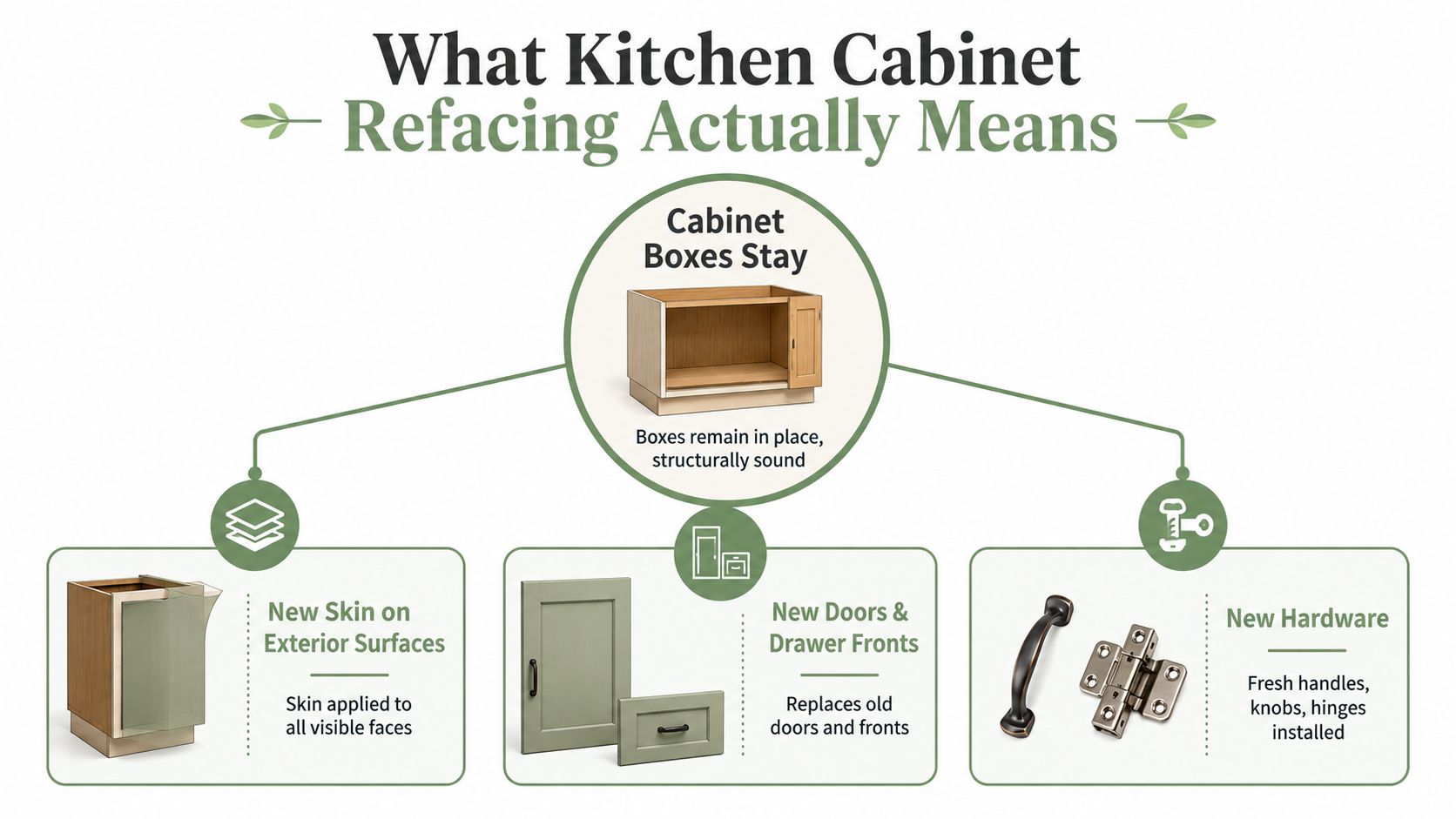
Kitchen cabinet refacing changes the cabinet's visible exterior while preserving its existing boxes. A contractor removes the old doors and drawer fronts, covers the exposed frame and end panels with a new veneer, laminate, or another approved skin, then installs new doors, drawer fronts, hinges, pulls, and knobs.
That makes refacing different from two services homeowners often confuse with it:
- Refinishing: The contractor cleans, sands, repairs, stains, or paints the existing doors and cabinet surfaces. The original doors and drawer fronts remain.
- Refacing: The boxes remain, but the visible skins, doors, drawer fronts, and often the hardware are replaced.
- Full replacement: The old boxes are removed and new cabinetry is installed, usually allowing changes to layout, storage, and appliance openings.
A simple car analogy helps. Refinishing is like repainting the car you already own. Refacing is like keeping the frame but installing new exterior panels, trim, and handles. Replacement means building a different car from the ground up.
The parts that stay
Refacing doesn't make every cabinet component new. The cabinet boxes remain, and the original drawer boxes usually remain unless the project includes a separate drawer-box upgrade. Interior shelves, cabinet interiors, and some internal hardware may also remain. A contractor should identify these items clearly in the proposal.
The boxes form the foundation. They need to hold fasteners, support shelves, accept new skins, and remain stable through Austin's heat and moisture cycles. Industry guidance commonly discusses 1/8-inch or 1/4-inch plywood with veneer-core or MDF-core construction as substrates for refacing side panels, because these materials provide a flatter, more predictable surface than deteriorated cabinet faces. WalzCraft's technical guidance on veneer, plywood, and MDF explains the trade-offs between stiffness, machining, moisture sensitivity, and fastener performance.
Refacing changes the working surfaces you see every day, but it doesn't rebuild a weak cabinet underneath.
That's why a professional inspection should come before color selection. A beautiful new door attached to a damaged box is still a damaged cabinet.
How the Refacing Process Works Step by Step
Refacing works like rebuilding the exterior of a house while keeping its foundation. The cabinet boxes are that foundation, so the inspection comes before finish samples. If the boxes cannot hold fasteners or stay stable through Austin's heat and humidity, new doors will only cover a structural problem.
Inspect the cabinet boxes first. The contractor checks cabinet floors, the sink base, side panels, shelves, face frames, and hinge attachment points. Water damage, sagging shelves, soft particleboard, swollen edges, or repeated hinge failure may make replacement more practical.
Remove the old components. Doors, drawer fronts, hinges, pulls, knobs, and other hardware come off. Openings are labeled or recorded when door sizes vary or corner cabinets have unusual configurations.
Prepare every surface. Grease, dust, wax, and cooking residue interfere with bonding. The exposed areas are cleaned, lightly sanded or scuff-sanded, repaired where appropriate, and cleared of dust. Preparation also affects refinishing, and industry guidance on cabinet preparation identifies degreasing, sanding, repairs, filling, and dust removal as steps before coating.
Austin's humidity makes this stage more demanding around sinks and dishwashers. Any swollen or soft material must be addressed before it is covered.
Apply the new skin. Based on the specification, the installer applies veneer, rigid thermofoil, or laminate to face frames, end panels, and other visible surfaces. Seams and edges need careful treatment beside wet or hot appliances, where moisture and heat can test the bond.
Fit the new doors and drawer fronts. These pieces are measured and ordered for the individual kitchen. Custom fronts often arrive after preparation, because their dimensions and construction must be verified before installation.
Install and adjust the hardware. New hinges, pulls, knobs, and soft-close components complete the functional update. The installer checks door reveals, drawer alignment, and corner clearances so the new parts open without interference.
Why the inspection controls the project
Each step depends on the one before it. Veneer needs a stable bonding surface, hinges need solid material for their screws, and new doors need boxes that remain square enough for consistent gaps. A separated face frame or swollen sink base can leave the finished kitchen looking improved while the underlying failure continues.
Refacing is commonly faster than full replacement. A Home Depot cabinet refacing cost guide reports installation ranges of 3 to 5 days, compared with 3 to 4 weeks for a full renovation, and describes 2 to 5 days for a standard 20-linear-foot kitchen. These are common project ranges, not a promise for every Austin kitchen.
Refacing vs Refinishing vs Full Replacement
The right method depends on what you want to change. If the doors have a workable style and the finish is failing, refinishing may solve the appearance problem. If the layout works but the doors, profiles, and hardware feel dated, refacing offers a larger visual change without removing the boxes. If the room needs new storage, altered appliance openings, or relocated plumbing, replacement belongs in the conversation.
| Method | Cost per Linear Foot | Timeline | Disruption | Expected Lifespan |
|---|---|---|---|---|
| Refinishing | Lowest of the three options, with project pricing based on preparation and finish condition | Usually shorter than refacing or replacement | Low to moderate, with doors and work areas temporarily unavailable | Depends on the original doors, preparation, coating, heat, steam, and maintenance |
| Refacing | Middle option, because new doors, fronts, skins, and hardware are installed | Commonly measured in days rather than several weeks, depending on scope | Moderate, but without full cabinet demolition | Professionally refaced cabinets commonly last about 10 to 20 years when materials and installation are appropriate, according to WalzCraft's refacing material guidance |
| Full replacement | Highest option, because new boxes, doors, installation, and related work are included | Often several weeks when demolition and associated remodeling are involved | Highest, with demolition and possible changes to counters, flooring, plumbing, or electrical | Depends on the cabinetry, installation, moisture control, and use |
Refinishing has a built-in limitation. The existing door profile remains, and previous paint failures, deep grooves, swollen edges, or weak joints may remain visible or compromise the result. A carefully prepared, sprayed finish can look smooth, but the original construction still controls the outcome.
Refacing gives you more design control. You can choose a new Shaker profile, a wood appearance, contrasting island doors, or different hardware while retaining a familiar storage arrangement. It won't correct a poor layout, add substantial storage, or make a narrow work triangle function differently.
Austin's moisture test
Central Texas conditions add another filter. Near a sink or dishwasher, water and steam can reach MDF edges and adhesive seams repeatedly. A painted finish over a water-damaged substrate may fail quickly, so homeowners should not choose refinishing merely because it has the lowest initial scope. Restore My Kitchen ATX's cabinet refinishing service is one example of a service that focuses on restoring existing cabinetry, but the cabinet condition still determines whether restoration is appropriate.
The deciding factor is usually scope of change, not budget alone. A functional kitchen with stable boxes is a refacing candidate. A damaged or poorly planned kitchen needs a more fundamental solution.
Materials and Finishes That Hold Up in Austin Kitchens
A pantry run in Dripping Springs faces different conditions from the cabinet beside an oven in Pflugerville. That contrast is the starting point for material selection. The existing cabinet box is the foundation, and the new surface must suit the heat, steam, moisture, and daily use around it.
Wood veneer
Wood veneer places a thin layer of real wood over a stable substrate, creating natural grain without replacing the entire cabinet structure. Peel-and-stick systems can speed installation, but the surface still needs proper preparation, and exposed edges must be sealed carefully.
Veneer suits homeowners who want warmth, visible grain, and a coordinated wood appearance. Near sinks, dishwashers, and steam-producing appliances, it requires closer attention because wood and its substrate respond to moisture and temperature changes. The WalzCraft substrate guidance discussed earlier explains why stable plywood and MDF-core components support predictable bonding and flatness.
Rigid thermofoil
Rigid thermofoil, commonly called RTF, is a vacuum-formed vinyl surface over an MDF core. It works well for smooth, easy-to-clean faces and the white Shaker style common in newer kitchens. Concentrated heat and steam create its main risk. Poor installation or limited ventilation can allow the surface to delaminate.
RTF is a reasonable choice for pantry cabinets and lower-stress runs. I would specify it more cautiously beside a dishwasher, oven, or cooktop, especially where ventilation is limited.
High-pressure laminate
High-pressure laminate, or HPL, forms a hard surface that handles routine wear, moisture, grease, and kitchen cleaning. It offers fewer color and edge-profile options than painted doors or wood, but those trade-offs can make sense in areas with heavier exposure.
The finish system also affects service life. Harder films generally handle scratching, grease, moisture, and repeated temperature changes better than standard brushed paint. KT Cabinet Refacing's durability guide compares HPL, thermofoil, catalyzed conversion-varnish systems, and standard painted finishes.
Solid wood doors
Solid maple, alder, and rift-sawn white oak remain common choices in Austin remodels. They can pair with veneer, laminate, or paint on the existing boxes, giving the doors a more substantial construction while keeping the cabinet foundation in place.
For Central Texas kitchens, a practical rule is use HPL or a well-specified solid wood door near high heat and moisture, and reserve RTF for lower-stress areas away from steam. Indoor humidity control supports wood stability too. A regional hardwood guide recommends 35% to 55% indoor relative humidity for quality hardwood performance, a useful reference alongside these Austin humidity and wood stability considerations. Homeowners can also review ways to protect cabinet finishes in Texas humidity before choosing materials and placement.
Cost, ROI, and When Refacing Is the Wrong Move
A refacing quote makes sense only after you judge the cabinet boxes. They are the kitchen's foundation, much like framing beneath a new exterior finish. If that foundation is sound, refacing can deliver a substantial visual change without rebuilding every cabinet. If it is failing, new doors only hide the problem temporarily.
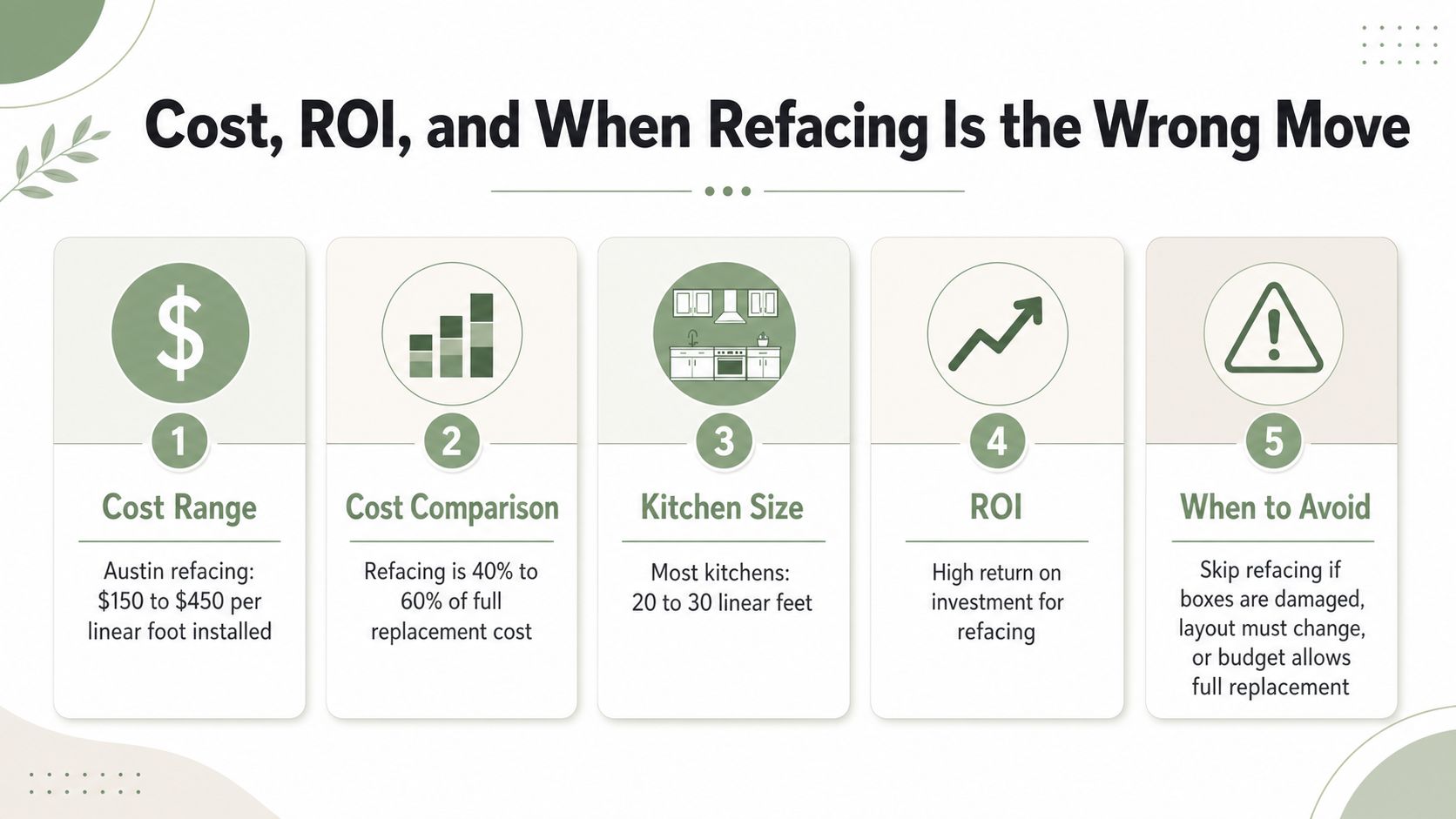
Refacing sits between refinishing and replacement in scope and price. In Austin, installed refacing commonly runs $150 to $450 per linear foot, or roughly 40% to 60% of full replacement cost, with many kitchens landing between $8,000 and $20,000. These figures come from the cabinet refacing cost and ROI reference. Your actual quote still depends on door count, end panels, material, hardware, repairs, and installation conditions.
The resale case can also be strong when the existing layout already works. The National Association of Realtors' 2022 Remodeling Impact cycle gave cabinet refacing a 100% cost recovery benchmark, a $13,000 median project spend, and a Joy Score of 9.7 out of 10. Later reporting cited a 97% ROI in the latest cycle context. CarolinaRen cites those figures from the National Association of Realtors report, but they remain benchmarks rather than a promise about an Austin home's resale price.
The material and landfill argument
Refacing keeps usable cabinet boxes in service instead of sending the entire cabinet system to demolition waste. That may reduce disposal, although the environmental result depends on what the contractor removes, how materials are handled, and whether damaged components still need replacement.
A homeowner in Bee Cave or Georgetown may value that reduction alongside appearance and resale efficiency. The project updates the room while preserving cabinet structure that still performs its job.
When replacement makes more sense
Austin's humidity and repeated moisture exposure make the condition check especially important. Refacing is the wrong move when the foundation cannot support the new work. Watch for:
- Soft or swollen boxes: Inspect the sink base, dishwasher side, and cabinet floors closely.
- A failing layout: Refacing cannot move plumbing, electrical, appliances, or storage zones.
- Widespread attachment failure: Repeatedly broken or rusted hinges may point to deeper damage.
- A need for substantial expansion: A new island, taller cabinets, or redesigned storage may justify replacement.
- A short-lived cosmetic fix: Covering damaged particleboard postpones the structural decision.
For a kitchen that needs layout changes, Restore My Kitchen ATX's full kitchen remodeling service reflects the broader scope to discuss. Refacing earns its value by preserving a reliable foundation, not by pretending to solve structural or planning problems it was never designed to address.
An Austin Homeowner's Refacing Readiness Checklist
Use this checklist to reach a preliminary yes, no, or maybe before scheduling contractor visits. It won't replace an inspection, but it will help you describe the kitchen accurately and recognize when a low quote may be avoiding an important condition.
Box condition
Yes means the cabinet floors feel firm, shelves sit level, face frames remain attached, and the sink base shows no swelling. No means you find soft material, water staining with active deterioration, sagging shelves, stripped hinge screws, or visibly warped panels. Maybe applies when damage appears limited to a replaceable panel and the contractor can explain the repair in writing.
Humidity tolerance
A kitchen with good ventilation and controlled indoor conditions gives finishes a better working environment. A room that steams heavily, traps heat beside the dishwasher, or sits near a moisture-prone area around Lake Travis needs more careful material selection and edge sealing.
- Yes: Exhaust ventilation works, steam clears quickly, and high-exposure cabinets can receive HPL or another suitable system.
- No: Moisture remains trapped, the sink base is repeatedly wet, or existing edges are already lifting.
- Maybe: The cabinet boxes are solid, but ventilation improvements and a different finish specification are needed first.
Timeline tolerance
Refacing suits households that want a shorter installation period and can work around temporary access to doors, drawers, and cabinet contents. Replacement creates more disruption because demolition can affect counters, flooring, walls, plumbing, and electrical work.
Budget signals
A refacing conversation makes sense when the layout works, the household plans to stay long enough to enjoy the improvement, and the project scope falls comfortably below replacement. A replacement conversation makes more sense when resale timing, storage limitations, or planned construction already point toward a broader remodel.
Homeowners in Kyle, Hutto, Buda, or Driftwood should run this checklist before requesting quotes. Arriving with photos, cabinet measurements, and notes about leaks prevents wasted walkthrough time and makes it harder for anyone to oversell a finish over a weak foundation.
Common Refacing Myths and What to Do Next
Myth one: Refacing is a fancy paint job. It isn't. Refinishing applies a new coating to existing surfaces, while refacing replaces the doors, drawer fronts, visible skins, and usually the hardware. The cabinet boxes remain, but the parts that define the kitchen's appearance are new.
Myth two: Refaced cabinets are automatically lower quality than new cabinets. Quality depends on the boxes, substrate, finish system, door construction, preparation, and installation. A well-installed HPL, thermofoil, veneer, or catalyzed finish can suit demanding kitchen conditions, while brand-new cabinetry can still perform poorly if moisture reaches unsealed edges.
Myth three: Any contractor can reface a kitchen properly. Refacing requires accurate measurements, clean bonding surfaces, consistent seams, stable substrates, and careful humidity planning. A contractor who only offers painting may not have the equipment or process for door replacement and veneer installation.
Before a quote, take four practical steps:
- Inspect the boxes: Photograph water damage, swollen particleboard, soft floors, and loose hinges.
- Count the components: Record doors, drawers, exposed end panels, and unusual corner pieces.
- Photograph in daylight: Natural-light photos reveal uneven color, edge swelling, and finish failure.
- Ask direct questions: What material fits your ventilation setup? What warranty covers peeling at seams? How will the installer handle humidity-related expansion?
Refacing deserves to be treated as a legitimate structural decision. You're deciding whether the cabinet foundation is worth preserving, then choosing a new exterior system that can live with the kitchen's actual heat, moisture, and daily use.
Restore My Kitchen ATX provides cabinet refinishing, painting, restaining, cabinetry coordination, and full kitchen remodeling for homeowners across the Austin metro area. If you're comparing refacing with restoration or replacement, visit Restore My Kitchen ATX to discuss your cabinet condition, finish goals, and project scope.