September 18, 2026
How to Clean Countertops Stains the Right Way
Saturday morning in an Austin kitchen rarely stays tidy for long. A child squeezes tamarind juice over the peninsula, coffee pools beside the espresso machine, and a tipped wine glass sends red liquid across the island. The instinct is to reach for the strongest cleaner in the cabinet, but that's usually backward. How to clean countertop stains successfully depends less on finding a miracle chemical and more on responding quickly, identifying the surface, and stopping before cleaning becomes damage.
Table of Contents
- Why the First 24 Hours Decide the Stain
- Know Your Countertop Before You Scrub
- The Universal First-Response Routine
- When a Poultice Is the Right Fix
- Material-Specific Removal Playbooks
- When It Is Not Actually a Stain
- Prevention and a Local-Area Maintenance Rhythm
Why the First 24 Hours Decide the Stain
A fresh spill is usually sitting on the finish or just beginning to enter the surface. Blotting lifts more of it before pigment spreads, while warm water and mild dish soap can remove residue without attacking the countertop. Leave that same coffee, wine, turmeric, or oil until the next day, and the cleanup becomes less predictable.
The Consumer Reports countertop testing summary describes testing across 14 countertop materials using staining, slicing, scratching, scorching, and nicking. Quartz performed especially well against stains and required no sealing, while more porous materials, including marble, granite, quartzite, and concrete, depended much more on prompt spill cleanup and periodic sealing. The practical lesson is simple: on stone, the stain-removal window starts when the spill happens, not when the mark becomes obvious.
What changes as the spill sits
During the first minutes, blotting can remove liquid without pushing it outward. Over the following hours, pigment can work into pores, oil can migrate below a sealer, and residue can dry into a ring. In Central Texas, hard-water minerals can complicate that ring by leaving a pale deposit as moisture evaporates. Humidity around Austin, Round Rock, Leander, and Cedar Park can also slow drying, leaving a damp spill in contact with the finish longer.
A 2026 homeowner guide claims that catching a stain within 24 hours removes about 90% of stains yourself. That figure appears in This Old House's countertop stain guidance, but it should be treated as a practical response-window rule rather than a promise for every material or spill. A porous concrete surface and a nonporous quartz surface won't respond the same way.
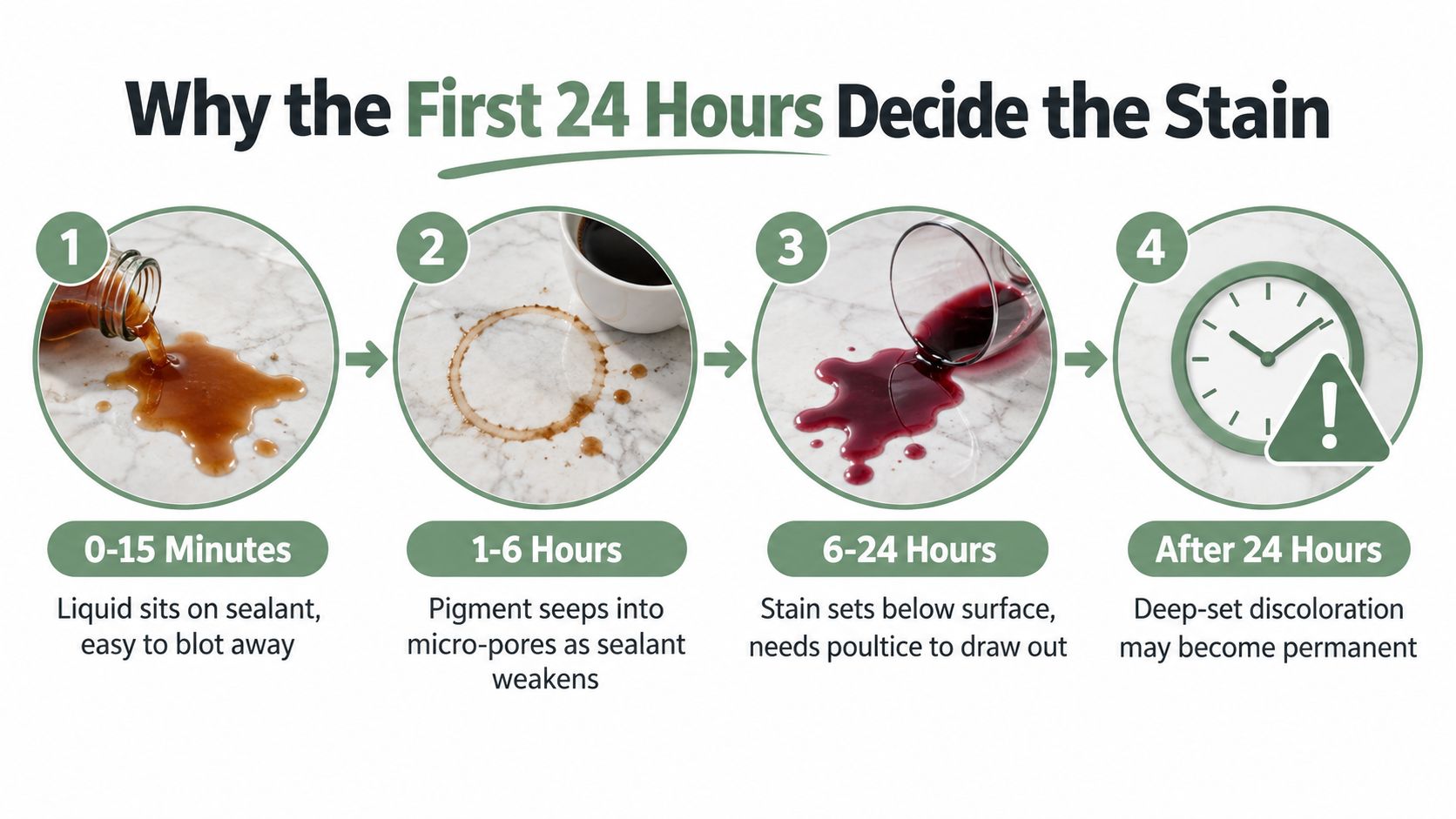
Practical rule: Blot the spill now, clean it gently, and wait before escalating. Time is the most useful ingredient in stain removal.
Know Your Countertop Before You Scrub
A cleaner that works on granite can damage laminate. A method suited to butcher block can leave quartz dull or discolored. Before treating the mark, identify whether the surface is porous stone, resin-based, plastic-laminated, or wood. That choice determines the cleaner, dwell time, and amount of pressure the finish can tolerate.
Granite is natural stone with variable porosity. Results depend on the stone and the condition of its sealer, which makes cooking oil and avocado oil difficult problems. Quartz combines mineral material with resin binders and usually resists stains well, but strong pigments and unsuitable cleaners can affect the resin or sheen. Quartz-care guidance from Stone Tech Fabrication recommends mild dish soap and warm water for routine cleaning, with gentle treatment for coffee, tea, soda, grease, and oil.
Laminate has a plastic wear layer, yet seams and chipped edges can draw liquid into the substrate. Ink may become a seam problem instead of a surface mark. Butcher block is absorbent wood, so oil and colored liquids can move into the grain. Red wine may travel below the surface rather than remain in a wipeable film.
| Material | Porosity | Sealing Needed | Top Stain Risk | Austin-Specific Concern |
|---|---|---|---|---|
| Granite | Variable, often porous | Check and maintain the sealer | Cooking oil and avocado oil | Hard-water residue can hide darkening around worn areas |
| Quartz | Low surface porosity, resin-bound | Usually no sealing | Turmeric, coffee, tea, and soda | Strong window light can affect some resin and pigment systems |
| Laminate | Low on the top layer, vulnerable at seams | No stone sealer | Ink at seams and chipped edges | Humidity can encourage moisture under compromised seams |
| Butcher block | Absorbent wood grain | Food-safe oil protection | Red wine and cooking oils | Dry air, humidity, and heat can open or stress the grain |
The material often matters more than the cleaner. Independent natural-stone countertop testing found concrete was severely stained by dye and turmeric, while the tested granite, engineered quartz, and sintered surfaces did not retain permanent stains after cleaning. For a remodel, this countertop material selection guide helps compare porosity, maintenance, and daily kitchen habits before a spill exposes the wrong choice.
The Universal First-Response Routine
Start with the same restrained routine on nearly any countertop. It removes fresh residue while protecting the finish, and it gives you a clean baseline before you decide whether the mark needs a material-specific treatment.
Use less pressure, not more product
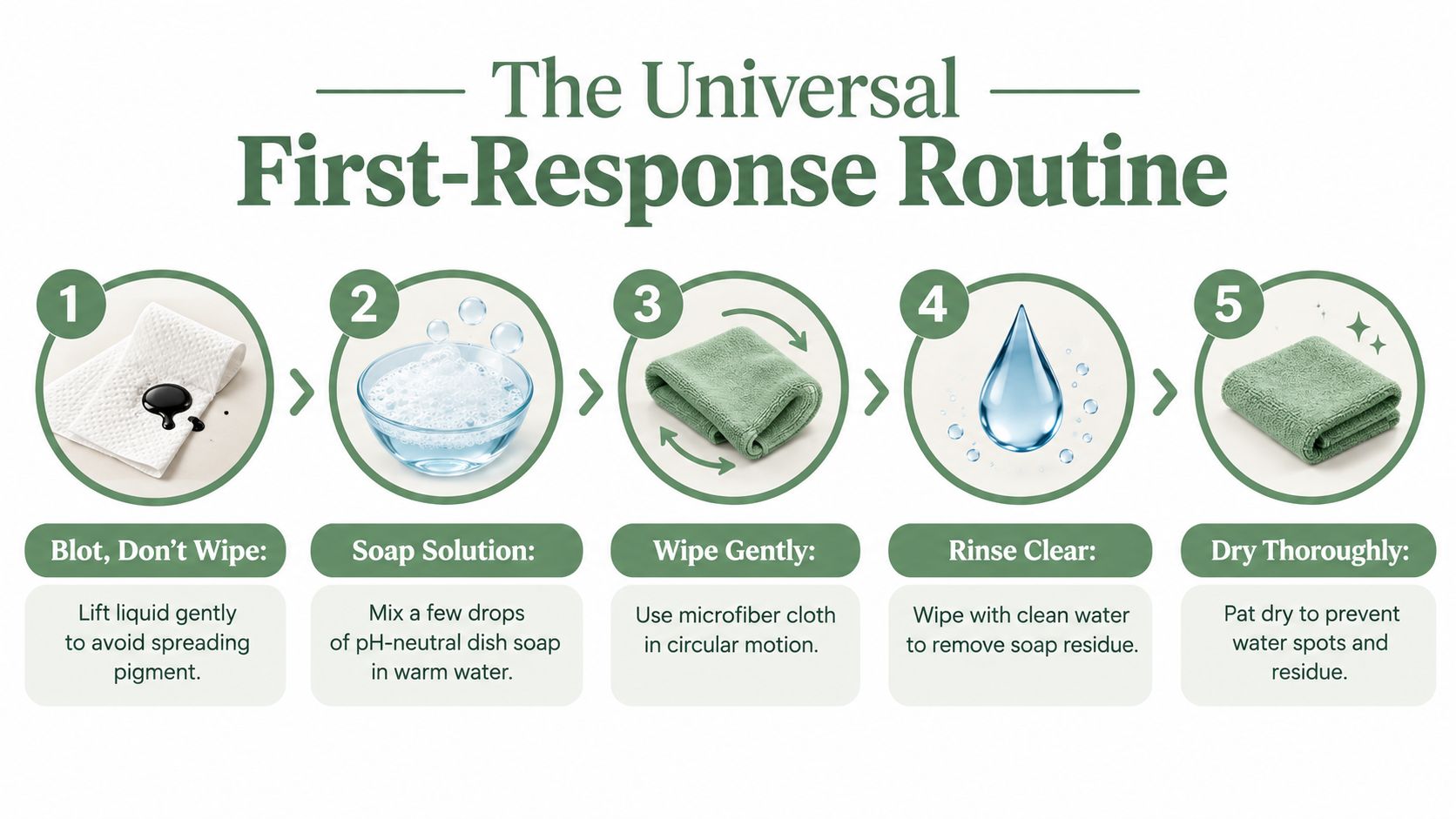
Blot the spill. Press a clean paper towel or microfiber cloth onto the liquid and lift it. Don't wipe across the surface, because wiping spreads pigment and enlarges the affected area. Neutral stone-care guidance from the Natural Stone Institute also recommends blotting rather than wiping.
Mix a mild solution. Add a few drops of pH-neutral dish soap to warm water. Avoid turning the mixture into a concentrated degreaser. The goal is to loosen residue, not leave a heavy film.
Wipe from the outside inward. Use a soft microfiber cloth and gentle circular motion, starting beyond the visible edge and moving toward the center. This limits the halo that forms when a liquid ring is pushed outward.
Use baking soda only after washing. For a water-soluble mark that has set, combine two parts baking soda with one part water to form a paste. Apply it for 5 to 10 minutes, then lift it with a damp cloth. Home Depot's countertop cleaning guidance emphasizes gentle treatment, rinsing, and thorough drying.
Rinse and dry completely. Wipe away soap and paste with clean water, then buff dry. In Austin, Lakeway, Bee Cave, and West Lake Hills, hard-water residue can create its own ghost ring if you leave the surface damp.
Skip steel wool, gritty scouring pads, and aggressive rubbing. Vinegar and lemon also belong off natural stone because acids can etch the finish rather than remove a stain. If the mark remains after this routine, don't assume more pressure will solve it. The surface may need a poultice, a different material-safe treatment, or repair.
When a Poultice Is the Right Fix
A poultice earns its place when a stain has moved below the surface. Instead of only cleaning residue from the top, it holds an absorbent paste against porous stone while the paste dries. That drying process can draw trapped material back toward the surface.
A baking soda paste may improve a fresh red-wine splash, but it may not clear a turmeric mark that has remained for two days. Turmeric and other dyes are especially difficult on porous surfaces. The longer they sit, the less likely a quick surface wipe will finish the job.
Choose the liquid for the stain
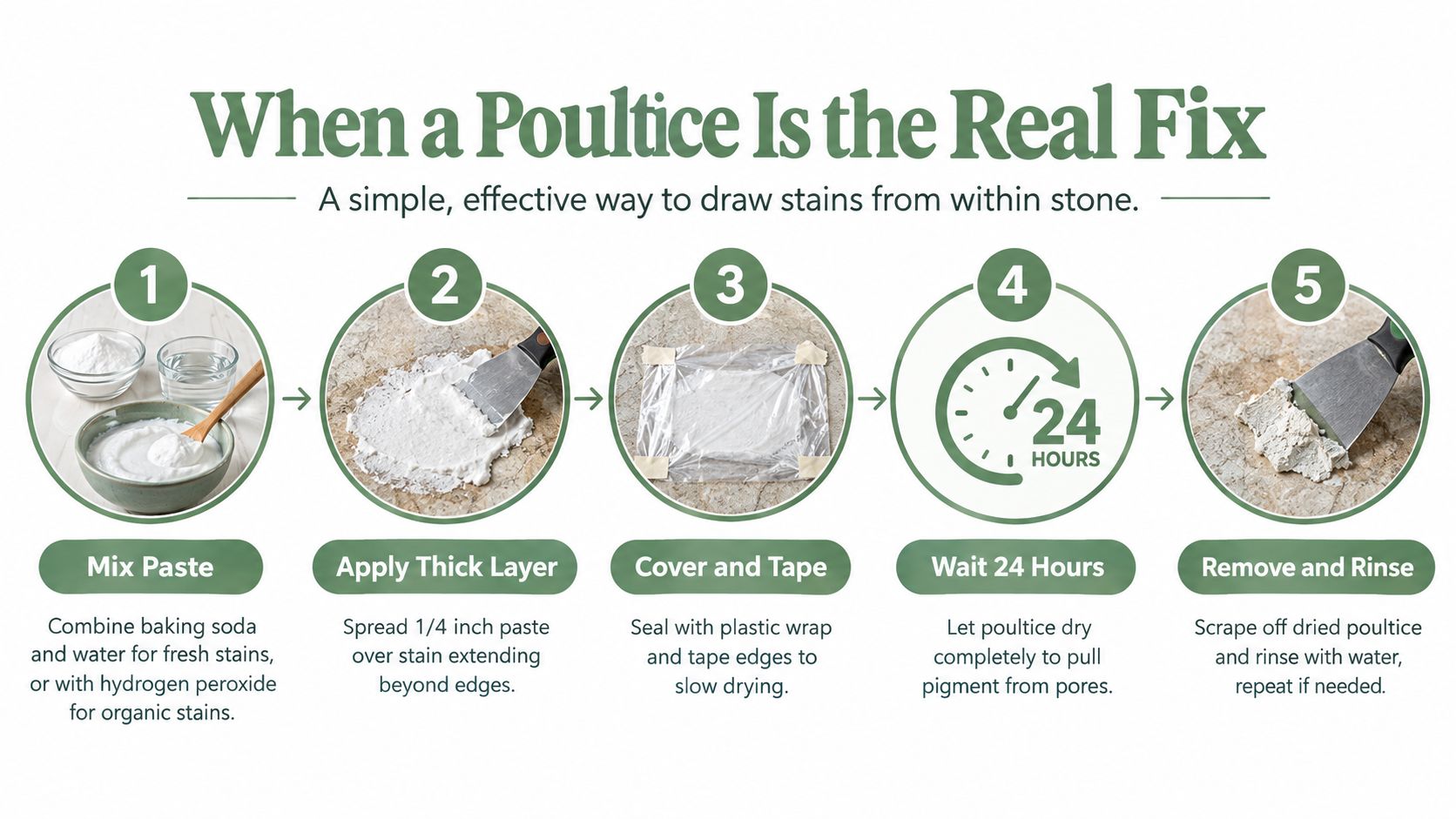
For a water-based or organic mark, mix baking soda with enough water to form a thick paste, about the consistency of peanut butter. For organic stains, a published quartz method places a cloth soaked in hydrogen peroxide beneath plastic wrap, allowing about 30 minutes for light stains and up to 2 hours for deeper stains. DG Floors' quartz stain guidance also describes baking soda mixed with 3% hydrogen peroxide for organic stains. Confirm that the treatment suits the surface before applying it. Quartz is engineered, and its finish can still react poorly to improvised chemicals.
Oil requires a different solvent choice on natural stone. The SlabWise oil-stain poultice method recommends a thick, peanut-butter-like paste applied about 1/4 inch thick, covered tightly, and left for 24 to 48 hours. Acetone is not a general countertop cleaner. Use it only when the material and finish can tolerate it, and test an inconspicuous area first. Mineral spirits may also be appropriate for some stone, but the wrong solvent can affect sealer or finish.
Apply, cover, and let it dry
Spread the paste over the mark and slightly past its edges. Cover it with plastic wrap, tape the perimeter, and make a few small holes when controlled evaporation is needed. Leave the poultice undisturbed until fully dry. Removing it while wet shortens the drawing-out process.
After drying, lift the residue with a plastic scraper. Wash with mild soap and water, rinse thoroughly, and dry the stone. A stubborn mark may need another gentle application, but repeated failure points to a mismatched treatment, weakened sealer, or damage that is not removable dirt.
Stop point: If the color does not change after a properly matched treatment, stop increasing solvent strength or scrubbing force. Protecting the finish matters more than chasing the last shadow.
Material-Specific Removal Playbooks
A countertop can look clean after wiping and still hold pigment or oil below the surface. The material determines how much moisture, friction, dwell time, and solvent it can tolerate. Start with the gentlest method that matches both the stain and the surface.
| Stain Type | Granite | Quartz | Laminate | Butcher Block |
|---|---|---|---|---|
| Coffee or tea | Mild soap first, then a suitable peroxide poultice | Baking soda paste with gentle motion | Baking soda paste and soft cloth | Clean, dry, and check grain penetration |
| Red wine | Blot, wash, then use an organic-stain poultice if needed | Baking soda paste, rinse, and dry carefully | Mild soap, then cautious paste treatment | Sand set-in discoloration along the grain |
| Cooking oil | Baking soda plus acetone poultice where suitable | Dish soap on a cloth, with very short solvent contact only when appropriate | Avoid acetone, especially near seams | Clean, sand if needed, then re-oil |
| Turmeric or curry | Treat promptly, then poultice if pigment entered the stone | Baking soda paste, avoiding harsh chemicals | Gentle paste, no bleach | Sanding may be needed if pigment entered the wood |
| Ink | Blot without spreading; seek stone-safe guidance | Use only a compatible, short-contact treatment | Focus on the surface and protect seams | Sanding can remove a shallow mark |
Granite
Coffee and wine on granite often respond to careful washing followed by a baking soda and hydrogen peroxide poultice. Oil needs a different treatment. On suitable natural stone, an acetone-based poultice can draw oil from the pores, but test first and keep the solvent off the polished surface for no longer than necessary. Aggressive scrubbing can roughen the finish without removing the discoloration.
Granite varies by color, finish, porosity, and sealer condition. If water darkens the area quickly after cleaning, absorption may be exposing a weak sealer rather than leftover grime. Dry the surface fully before judging the result, especially in humid Austin weather, where moisture can linger in pores and around edges.
Quartz
Quartz usually needs less intervention. Warm water, mild dish soap, and a soft cloth handle routine residue. For stubborn coffee, tea, or soda, work a baking soda paste with light circular motion, then rinse thoroughly and dry. Grease generally responds to dish soap on a cloth.
Hydrogen-peroxide treatments may help deeper marks, but quartz resin limits the margin for error. Strong solvents need very short contact, and any solvent should be tested in an inconspicuous spot first. Avoid bleach, oven cleaner, abrasive powders, and acidic products. A melamine sponge can lift dried residue, but use light pressure and stop as soon as the deposit releases. Stone Tech Fabrication's quartz care recommendations also support keeping quartz care mild and controlled.
Laminate
Laminate's top layer handles ordinary surface grime fairly well. A baking soda paste and soft-bristle brush can help, provided the work stays localized. The seam is the vulnerable area. Bleach and acetone can damage the finish or swell the substrate when liquid slips beneath the plastic layer.
Use little moisture and dry the edge immediately. Ink that has entered a seam may improve visually with surface cleaning, but the underlying substrate can remain marked. Austin's humidity makes that trapped moisture more consequential, so do not leave a wet paste or soaked cloth in place while chasing a faint shadow.
Butcher block
Wood absorbs stains, so set-in red wine or oil may not respond to soap alone. Sand with 220-grit paper along the grain, remove all dust, and apply food-safe mineral oil. Keep the sanding level and feather the surrounding area so the repair does not leave a hollow. Sanding across the grain creates scratches that collect new pigment and moisture.
A wood surface rewards quick cleanup, but it also needs a finish that is maintained consistently. Homeowners weighing that trade-off can review the return of warm wood in Austin kitchens, where the design appeal is considered alongside the upkeep it requires. Sun exposure can also dry or discolor exposed wood, so inspect areas near bright windows before treating every color change as a removable stain.
When It Is Not Actually a Stain
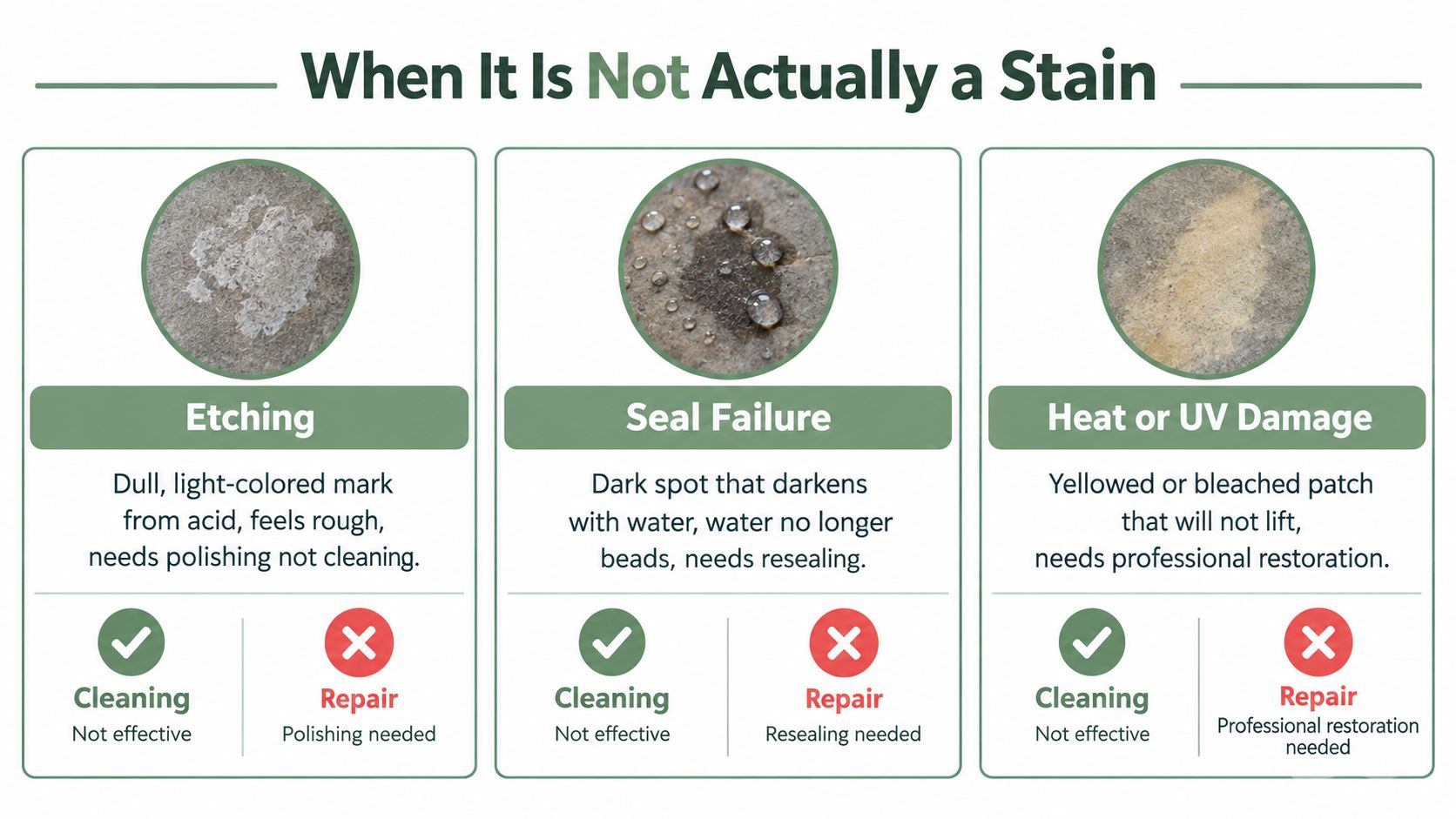
A darker, blotchy mark may be absorbed material. A dull, pale ring may be etching. Those problems look similar under a quick glance, but a poultice can address the first and do nothing for the second.
Etching happens when acid reacts with the stone surface, especially marble and other acid-sensitive finishes. Lemon, vinegar, wine, and some cleaning products can leave a dull or light-colored patch that feels different from the surrounding polish. No stain remover can pull out a chemical reaction that has changed the finish. The repair is polishing, honing, or professional refinishing.
Three clues worth checking
- Stain: The area is darker, discolored, or blotchy. A matched poultice may draw out absorbed material.
- Etching: The area is lighter or duller and may look rough when light hits it. Cleaning won't restore the sheen.
- Seal failure: The spot darkens when wet because liquid enters the stone quickly, then appears to return after cleaning. The remedy is resealing after the surface is fully dry.
Heat and ultraviolet exposure create another category. A yellowed or bleached patch near a sunny window isn't necessarily absorption. Quartz can be affected by strong UV exposure, and sealers or finishes can change under heat and sunlight. Cleaning won't reverse a color change.
A stronger cleaner can't repair a worn sealer or polish away an etch. It can only add another risk.
Prevention and a Local-Area Maintenance Rhythm
The easiest stain is the spill you remove before it settles. A workable routine doesn't require a cabinet full of specialty products. It requires consistent timing, clean cloths, and a little awareness of how Central Texas conditions affect finishes.
A practical rhythm
- Weekly: Wipe countertops with pH-neutral soap and warm water, then rinse and dry rather than allowing water to evaporate in place.
- Biweekly: Test granite by placing a few drops of water on a clean, dry area. If the stone darkens quickly instead of resisting absorption, discuss resealing rather than adding more cleaner.
- Quarterly: Perform a deeper clean with a compatible stone conditioner where the material allows it. Keep laminate and butcher block on their own care schedules.
- Annually: Check the condition of stone sealers, wood oil, laminate seams, and areas exposed to direct sunlight.
Hard water can leave mineral rings that look like stains. Humidity can slow the drying of a poultice and drive moisture toward laminate seams. Strong afternoon sun through west-facing windows in Austin, Buda, Kyle, Pflugerville, Georgetown, Hutto, Dripping Springs, and Driftwood can fade exposed finishes or change the appearance of resin and sealer systems. This guide to protecting finishes from Texas humidity covers the broader maintenance problem.
Keep a small response kit near the kitchen: microfiber cloths, paper towels, pH-neutral dish soap, baking soda, plastic wrap, painter's tape, a plastic scraper, and material-appropriate gloves. Use felt pads beneath oil bottles, set hot cookware on trivets, and keep a clean towel near the espresso machine. A spray bottle of 70% isopropyl alcohol can be used for daily disinfecting only when the countertop manufacturer permits it, followed by a clean-water wipe and thorough drying.
Pin this checklist inside a cabinet door:
- Spill: Blot immediately.
- Wash: Use mild soap and warm water.
- Paste: Apply baking soda only when needed.
- Rinse: Remove every trace of cleaner.
- Dry: Buff away water and residue.
- Inspect: Decide whether the mark is a stain, etch, seal failure, or finish damage.
- Escalate: Stop experimenting when the surface itself appears damaged.
Restore My Kitchen ATX helps Austin-area homeowners protect and renew kitchens through cabinet refinishing, painting, restaining, countertop update coordination, and full kitchen remodeling. If a persistent countertop mark is part of a wider worn or dated finish problem, visit Restore My Kitchen ATX to request a project consultation and custom quote.