August 31, 2026
Cabinet Refinishing Contractors: An Austin Homeowner Guide

You've lived with the same tired kitchen long enough. The oak looks orange, the cabinet doors feel sticky around the pulls, and the bathroom vanity has a water stain that keeps catching your eye. You search “cabinet refinishing contractors near me”, hoping to get a fresh-looking kitchen without tearing out countertops, opening walls, or living without a sink for a month.
That search gets serious in Austin because the wrong contractor can turn a manageable finish project into a long remodel. Texas heat, humidity, intense window exposure, and storm-related moisture all test cabinet coatings. A good crew changes the finish while preserving what already works. A careless one sprays over grease, skips bonding primer, and leaves you with peeling doors before you've had time to enjoy the new color.
Table of Contents
- The Moment Most Austin Homeowners Start Looking for Cabinet Refinishing Contractors
- What Cabinet Refinishing Covers in a Central Texas Home
- Refinishing vs Painting vs Restaining vs Full Replacement
- Inside a Factory-Grade Cabinet Refinishing Workflow
- Questions to Ask Cabinet Refinishing Contractors Before You Sign
- Timelines Costs and Warranties You Can Plan Around
- Austin Metro Service Areas and What Local Coverage Really Means
- Putting It All Together Before You Request a Quote
The Moment Most Austin Homeowners Start Looking for Cabinet Refinishing Contractors
The first search often happens at the kitchen island. A homeowner in Round Rock notices the yellowed lacquer on a 1990s oak kitchen. Someone in a Pflugerville starter home sees chipped doors every time they unload the dishwasher. In Lakeway, a larger build-out may still have sturdy cabinetry, but the stain feels dated against newer flooring and lighting.
The homeowner usually wants two things at once: a kitchen that looks current and a project that doesn't become a gut renovation. That's why the quote matters before the color does. The contractor has to determine whether the boxes, doors, and substrate can support a new finish, or whether the homeowner is trying to disguise damage that needs carpentry or replacement.
The problems that trigger the phone call
Common reasons Austin homeowners start interviewing cabinet refinishing contractors include:
- Yellowed or ambered finishes: South-facing windows can make older oak and knotty alder look uneven, especially where sunlight reaches the doors directly.
- Bathroom moisture damage: A stained vanity in a primary bath may need finish restoration, but swollen material near a plumbing leak may need replacement.
- Storm-related claims: An insurance scope after a storm may address structural or water damage while excluding cabinet finish work, leaving the homeowner to find a specialist.
- Outdated color: A sound stained kitchen may need a painted finish, not new boxes and countertops.
- Daily wear: Grease, cleaner residue, slammed doors, and repeated contact around handles expose weak preparation quickly.
Practical rule: A quote should explain how the contractor will protect the existing cabinet system, not just name a color and a total price.
A serious contractor also sets expectations around use. Sprayed doors need time to cure before they return to hinges and drawer slides, and Central Texas conditions can affect that schedule. Ask what happens if humidity rises, a gated community delays access, or a storm interrupts the planned workdays. The right short list starts with documented process, clear scope, and local experience, not the lowest number in your inbox.
What Cabinet Refinishing Covers in a Central Texas Home
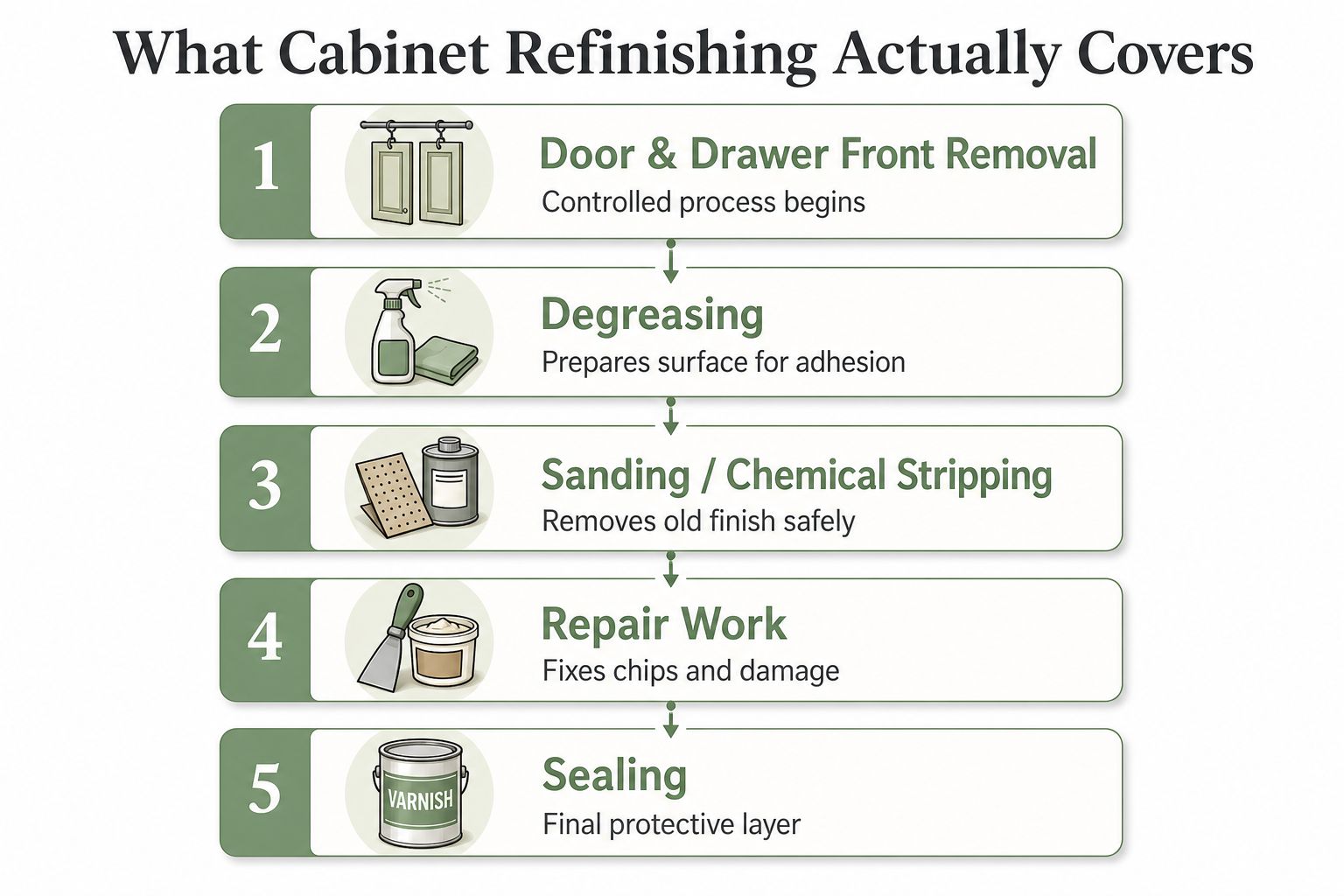
Cabinet refinishing is a finish-and-color restoration, not a change to the cabinet's geometry. A qualified crew removes doors and drawer fronts, labels hardware, degreases each surface, sands or strips the existing coating as needed, repairs chips and minor damage, seals problem areas, applies bonding primer, and sprays the finish under controlled conditions.
Preparation depends on the substrate. Solid wood and sound MDF generally provide a workable surface after proper cleaning and abrasion. Laminate and thermofoil need closer inspection because adhesion can vary, especially at edges and near heat or moisture sources such as a dishwasher. Peeling thermofoil or swollen material requires a repair or replacement decision before anyone applies paint.
What belongs in the scope
A proper assessment should address these work stages:
- Removal and labeling: Doors, drawer fronts, hinges, and hardware are identified so every piece returns to its original location.
- Decontamination: Degreasing removes cooking oils, polish, smoke residue, and cleaner buildup that can prevent adhesion.
- Mechanical preparation: Sanding creates the surface tooth needed for primer and finish. Chemical stripping may be appropriate when the existing coating is badly compromised.
- Repair and sealing: Small chips, dents, cracks, and exposed areas are corrected before coating. Water damage must be identified rather than covered.
- Spray finishing: Thin, even coats are applied with professional equipment, usually away from the kitchen in a controlled environment.
Austin-area conditions affect the plan. A south-facing oak kitchen in Cedar Park may need a different color strategy from a knotty alder kitchen in Bee Cave. A stained vanity in West Lake Hills can refinish well if the board remains solid, but no coating will restore particleboard swollen by a leak.
Central Texas heat, humidity, and storm exposure also affect curing and long-term coating performance. Review this guide to protecting cabinet finishes from Texas humidity. Refinishing will not add storage, move appliances, widen a walkway, replace swollen cabinet boxes, or correct a failed layout. Those needs call for remodeling or partial replacement, not a refinishing quote.
Refinishing vs Painting vs Restaining vs Full Replacement
Cabinet condition should drive the decision, not the popularity of a finish color. If the doors close properly, the boxes feel firm, and the substrate isn't swollen or crumbling, refinishing is usually the sensible starting point. Use the knock-and-squeeze test: tap the box and door, then apply gentle pressure around corners and joints. A solid, quiet response supports refinishing. Movement, swelling, or separation calls for closer inspection.
| Option | Best Cabinet Condition | Typical Austin Cost | Timeline | Best Fit |
|---|---|---|---|---|
| Refinishing | Sound wood, MDF, or suitable existing finish | $4,000–$9,000 | About one week | Color or sheen change while keeping the layout |
| Painting in place | Sound surfaces where speed matters more than a factory-style result | Qualitative quote required | Shorter than doors-off refinishing | Limited refresh or lower-disruption work |
| Restaining | Raw or stripped wood with useful, intact grain | Qualitative quote required | Depends on stripping and dry time | Restoring wood depth and tone |
| Full replacement | Swollen boxes, failed structure, wrong layout, or major remodel | Five figures and up | 6–12 weeks | New storage, geometry, or complete redesign |
These Austin cost and timeline ranges are planning bands, not promises. Door count, wood species, existing finish condition, repairs, color changes, hardware, and finish chemistry can move a quote substantially. A contractor should inspect the cabinet system before treating any range as a firm proposal.
When each option makes sense
Refinishing keeps the boxes, doors, countertops, and footprint. It's a strong fit for an outdated oak kitchen in Buda or Kyle when the homeowner likes the layout and wants a durable color change.
Painting in place can move faster, but it generally gives the crew less control over edges, backs, and film uniformity. It's not my preferred approach for a kitchen that gets heavy use, especially when the homeowner expects a factory-smooth result.
Restaining only makes sense when the wood itself is worth revealing. If the existing grain is thin, patched, badly stained, or covered by a coating that can't be removed without damaging the surface, painting may be more practical. For a cabinet painting scope, compare the process described by Restore My Kitchen ATX cabinet painting services.
Replacement wins when the layout is wrong, boxes have swollen from leaks, doors are warped, or you're already opening walls for plumbing, electrical, or structural work. It also makes sense when you need taller cabinets, different storage, or a new island configuration. Refinishing cannot solve a functional problem that lives inside the cabinet footprint.
Inside a Factory-Grade Cabinet Refinishing Workflow
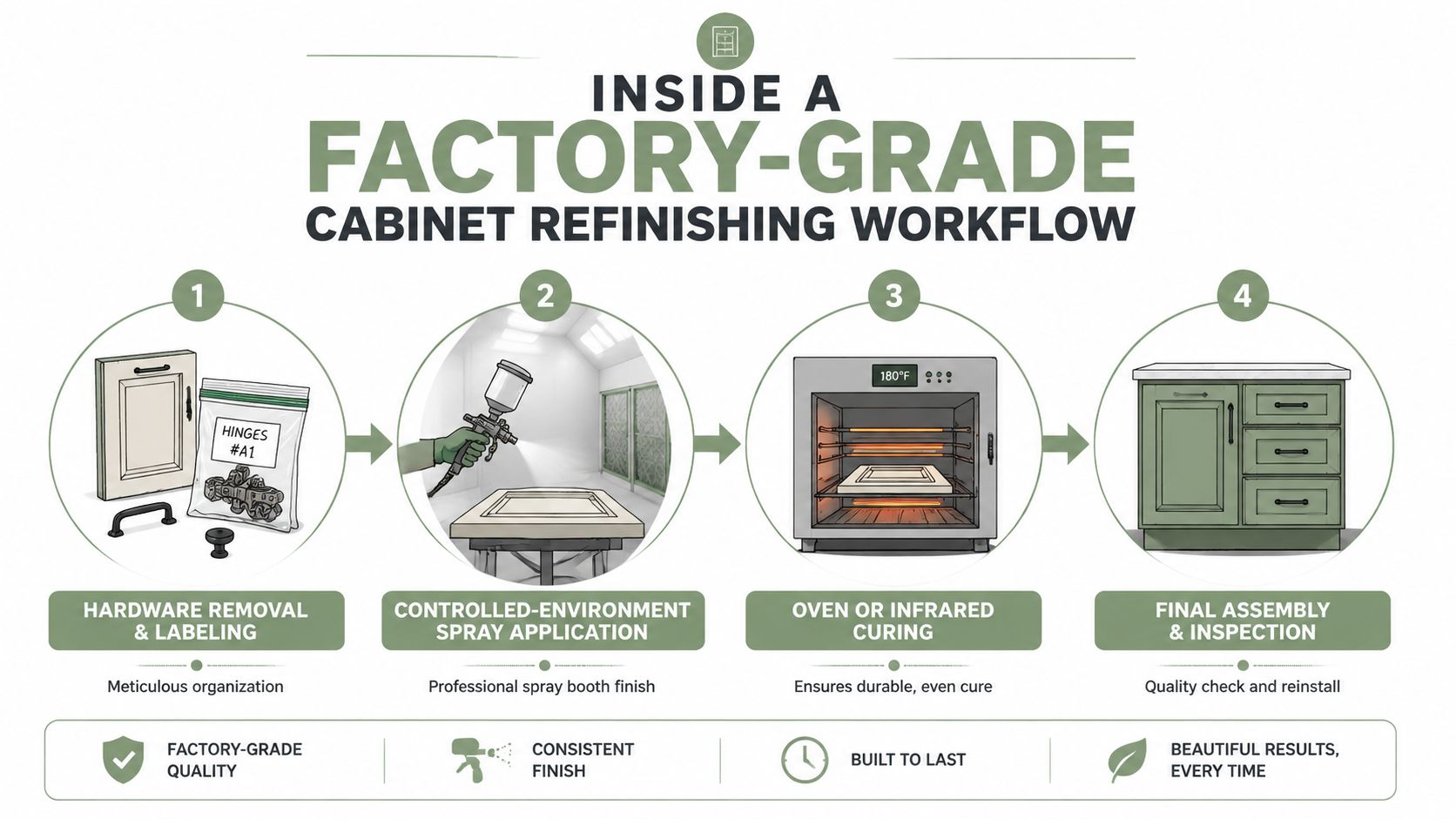
A factory-grade workflow begins with organization, not a sprayer. The crew removes each door and drawer front, labels the hardware, records locations, and transports removable pieces to a controlled spray area whenever the project setup allows it. The boxes stay protected in the home while the doors receive the same careful preparation on every face and edge.
The technical sequence matters. Finishing guidance recommends thorough degreasing, mechanical abrasion for adhesion, and consistent spray technique, with the gun held about 6 to 10 inches from the surface and passes overlapped to prevent striping and uneven film build, as described in this spray-finishing reference. Cabinet-grade coatings are commonly applied in thin films around 3 to 5 mils wet, because excessive film build can create sagging, longer dry times, and surface defects, according to the same technical reference.
What the crew should document
A credible workflow typically includes:
- Hardware removal and labeling: Bags, diagrams, and photographs prevent mismatched doors and misplaced hinges.
- Surface preparation: Degreasing comes before sanding. The contractor should explain what happens to glossy, contaminated, stained, or previously painted surfaces.
- Controlled spray application: A booth, dedicated shop, or carefully managed spray area reduces dust and makes atomization more consistent than casual brush work.
- Curing and drying: Oven or infrared curing may be used where appropriate, followed by controlled drying before assembly.
- Final inspection: The crew checks coverage, edges, sheen, hardware alignment, and door operation before reinstalling everything.
Austin summer conditions deserve a direct conversation. High humidity can lengthen drying and curing, while very hot kitchen temperatures can change how a coating flows and levels. A professional may move doors to a ventilated booth, dehumidify the work area, or tent and condition the space. If the contractor has no answer for heat, moisture, dust, or sudden weather changes, the process isn't controlled enough.
You can compare the stated workflow with the Restore My Kitchen ATX cabinet refinishing service, but ask every contractor for the same level of detail. A warranty has little value if the crew can't explain the preparation and cure conditions behind it.
Questions to Ask Cabinet Refinishing Contractors Before You Sign
Treat the estimate like a structured interview. You're not only choosing a color. You're choosing who will prepare the substrate, control the spray environment, handle your doors, and stand behind the finish after daily use begins.
Ask where the finish work happens
“Are the doors sprayed on-site, in your shop, or in a dedicated booth?” is a better question than “Do you spray?” Off-site or controlled-environment work usually gives the crew better control over dust, temperature, humidity, and overspray. A contractor who sprays in a garage or kitchen may still produce acceptable work, but should explain how the environment is controlled.
A credible answer names the workspace, protection methods, ventilation, and cure procedure. “We'll spray everything in the kitchen and it'll be ready tonight” deserves a second opinion.
Ask how the surface is prepared
Request the actual sequence. You should hear about degreasing, abrasion or stripping where necessary, repairs, primer, and inspection between coats. “We scuff it and paint it” is not a standard. It's a warning.
Ask how the contractor handles oak grain, dark stain bleed, thermofoil edges, old caulk, and areas near dishwashers or sinks. The answer should change according to the substrate instead of treating every door as identical.
Ask about chemistry and sheen
Request the primer and topcoat product names, not just “cabinet paint.” Waterborne systems can reach VOC levels at or below 50 g/L in some products, while cabinet coating manufacturers emphasize hardness, scratch resistance, and abrasion durability as performance targets, as shown in this cabinet coating technical data sheet. In demanding kitchens, two-component catalyzed polyurethane systems are often selected because cross-linking creates a harder, more chemical-resistant film than many one-component coatings.
Ask for sheen samples in your home's actual light. A bright white in a showroom won't look the same beside Austin limestone, warm flooring, or south-facing glass.
Ask about safety and paperwork
For homes built before 1978, ask whether the contractor follows lead-safe renovation practices and holds the relevant RRP certification. Also request proof of liability insurance and workers compensation coverage, written change-order terms, and references from comparable homes in Round Rock, Cedar Park, or your own part of the metro.
Red flag: A contractor who refuses to name the coating, won't explain prep, or changes the price verbally during the job is asking you to accept all the risk.
Timelines Costs and Warranties You Can Plan Around
A full Austin kitchen refinishing project commonly fits a one-week calendar window, with active work spread across several workdays. Doors may leave the home for preparation and spraying while the crew protects and finishes the boxes in place. The kitchen can look close to complete before the coating has reached its final chemical resistance, so “reinstalled” and “fully cured” aren't the same milestone.
One guide notes that many waterborne enamels reach handling hardness in 24 to 48 hours but may need 2 to 4 weeks for full chemical resistance, which is why a homeowner can use the kitchen while still treating the finish gently. The cabinet refinishing process guidance supports planning around that distinction.
| Project Scope | Typical Timeline | Austin Cost Range | Warranty Window | Notes |
|---|---|---|---|---|
| Small vanity or limited cabinet run | Short, project-specific schedule | Custom quote | Varies by contractor | Confirm substrate condition and moisture history |
| Standard full-kitchen refinish | About one week | $4,000–$9,000 | Written terms required | Door count, repairs, species, and finish system affect price |
| Extensive door repair or complex finish change | Longer than the standard window | Above the standard band may apply | Written terms required | Ask for a milestone schedule |
| Full replacement or major remodel | 6–12 weeks | Five figures and up | Contract-specific | Includes layout, cabinetry, and related trades |
May and June humidity spikes, extreme summer heat, appliance access, and HOA scheduling in communities around Steiner Ranch, Bee Cave, and Lakeway can stretch the calendar. Your contract should state whether weather-related delays change the completion date or add charges.
Read the warranty by failure type. Adhesion coverage is different from normal wear, scratches, impact damage, cleaning abuse, water intrusion, and color change caused by UV exposure. A strong written warranty identifies the coating system, preparation responsibility, covered failures, homeowner maintenance obligations, inspection process, and exclusions. “Lifetime” without definitions is marketing, not protection.
Austin Metro Service Areas and What Local Coverage Really Means
Service-area language can hide practical limitations. A contractor may advertise Austin metro coverage but charge for a long drive, restrict site visits to certain weekdays, or refuse off-site door transport from a gated community. Confirm the details before you schedule an estimate.
Central Austin, Round Rock, Cedar Park, Leander, Pflugerville, Lakeway, Bee Cave, Buda, Kyle, and San Marcos are commonly treated as core service territory by contractors that work throughout the metro. Coverage may also extend to Georgetown, Hutto, Dripping Springs, Driftwood, West Lake Hills, and Steiner Ranch, but distance and access rules can change the quote or schedule.
| Area | Typical Coverage | Common Add-Ons |
|---|---|---|
| Austin and West Lake Hills | Regular metro coverage | Parking, loading, or restricted-access coordination |
| Round Rock, Pflugerville, Hutto, and Georgetown | Often covered by north-metro crews | Longer routing or additional site visits |
| Cedar Park and Leander | Common suburban service zone | HOA scheduling and off-site door transport |
| Lakeway, Bee Cave, and Steiner Ranch | Regularly served by west-metro crews | Gate access, appointment windows, and distance review |
| Buda and Kyle | Common south-metro coverage | Travel coordination and appliance access |
| Dripping Springs and Driftwood | Coverage varies by contractor | Fuel or trip surcharge, rural access, longer scheduling window |
What to confirm in writing
Ask for the contractor's service radius in miles, not just a list of cities. Confirm whether a fuel or trip surcharge applies, where the doors will be sprayed, and whether transport is included. Older homes may also need appliance disconnection or special plumbing coordination, and many refinishing crews don't include that work.
Central Texas conditions make local experience useful. Heat above 100°F, humidity, intense UV exposure through large windows, and sudden downpours can affect spray conditions, curing, and exterior access. The contractor should explain how the team manages those variables without improvising on your project.
Request two recent addresses in your ZIP code. You don't need private homeowner details if the contractor can provide appropriate references or permission-based contacts. A crew that regularly works on your street or in nearby neighborhoods should understand parking, HOA rules, access windows, and the actual drive time.
Putting It All Together Before You Request a Quote
Start with the cabinet system, not the contractor's portfolio. Confirm that the boxes are solid, the doors operate correctly, and moisture damage hasn't compromised the substrate. If the layout works and the finish is the problem, refinishing deserves a quote. If storage, geometry, or swollen boxes are the problem, include remodeling or partial replacement contractors in your comparison.
Then build a short list of three contractors who serve your ZIP code. Ask each one the same questions about door removal, degreasing, sanding, primer, topcoat chemistry, spray location, curing, safety, insurance, change orders, and warranty coverage. You'll learn more from the specificity of the answers than from polished before-and-after photos.
Your pre-quote checklist
- Confirm condition: Check doors, face frames, boxes, hinges, sink areas, and dishwasher zones for swelling, movement, or failed substrate.
- Verify the workflow: Require a clear sequence for removal, labeling, preparation, spraying, curing, inspection, and reinstallation.
- Separate the quote: Ask the written proposal to identify labor, materials, repairs, doors-off handling, hardware work, appliance coordination, and travel fees.
- Review the warranty: Separate adhesion problems from ordinary wear, impact, cleaning damage, moisture intrusion, and UV-related finish changes.
- Check local references: Request recent comparable work in your city or ZIP code, including homes with similar cabinet materials.
- Plan the household: Confirm kitchen access, sink availability, pets, children, HOA rules, and the gentle-use period after reinstallation.

The cheapest bid often omits the work that protects the finish. If a contractor skips decontamination, rushes cure time, or won't document the coating system, the cost may arrive when doors peel in the next demanding Texas season. Choose the contractor who can show you how the result will be produced, not just promise that it will look great.
Restore My Kitchen ATX evaluates existing cabinets, provides cabinet refinishing, painting, and restaining, and coordinates full kitchen remodeling when the layout or cabinetry needs to change. Visit Restore My Kitchen ATX to request a project-specific estimate and discuss whether your Austin-area kitchen is a sound candidate for refinishing.